


A practical guide to giving feedback that people embrace


Feedback gets a bad reputation. For many people, the word alone triggers anxiety, defensiveness or dread. That is understandable.
Most of us have experienced feedback that felt like criticism. Or judgement. Or a surprise attack.
But in coaching, feedback has a very different purpose.
What feedback really is and why it matters
At its core, feedback is information.
Nothing more.
Nothing less.
Its intent is positive.
Always.
In a coaching context, feedback exists to support learning.
To deepen understanding.
To expand awareness.
When we offer feedback well, we help someone see what they cannot currently see.
Their blind spots.
The impact of their behaviour.
The ripple effect of their actions.
This increased awareness creates choice.
And choice is where growth lives.
The individual decides what to do with the data.
What to keep.
What to change.
What to experiment with.
Feedback is not about fixing people.
It is about empowering them to learn, reflect and choose.
That is why how we give feedback matters so much.
Why most feedback fails before it even starts
Even when intent is positive, feedback can miss the mark.
Usually for one simple reason.
The recipient is not ready to hear it.
No permission.
No context.
No emotional safety.
Without these, feedback feels imposed.
And imposed feedback is rarely embraced.
That is why we start with CDA.
The CDA model
Contract. Data. Action.
It creates the conditions for feedback to be received as learning rather than judgement.
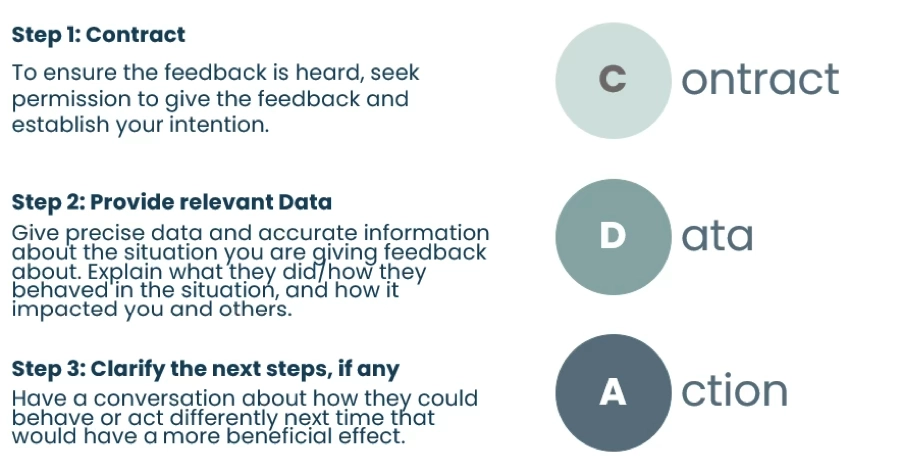
Let us explore each step.
Step 1. Contract
Get permission. Build readiness. Create choice.
Contracting means you explicitly check whether the other person is open to receiving feedback.
You invite them in rather than pushing information at them.
This reinforces the purpose of feedback as learning.
Not evaluation.
What contracting sounds like
- Would you be open to some feedback on that presentation
- Is now a good time to share an observation
- I have noticed something that may support your learning. Are you happy for me to share it
This step raises psychological safety.
It lowers defensiveness.
And it prepares the brain to listen rather than protect.
If the answer is no.
Respect it.
Agree another time.
Choice remains with the individual.
Step 2. Data
Share observations, not assumptions.
Once permission is given, you move into data.
This is where awareness is raised.
Data is what you noticed.
From your perspective.
Without judgement or interpretation.
To keep feedback clear and grounded, we use the SBI model.
The SBI model
Situation. Behaviour. Impact.
It provides a clean structure for sharing observations that support learning.
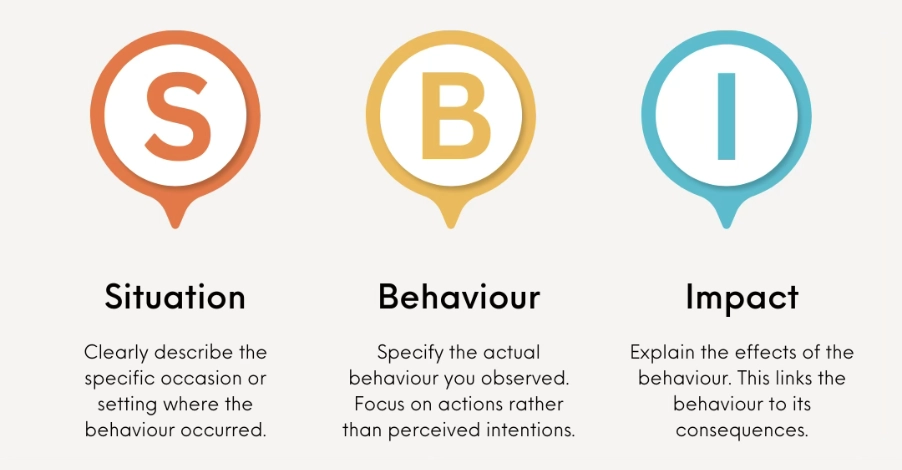
Situation
Anchor the feedback in a specific moment.
This helps the recipient recall the context and reduces confusion.
Examples
- In yesterday’s team meeting
- During the client call on Tuesday
- When we reviewed the project plan last week
Specific beats general every time.
Behaviour
Describe what you observed.
Stick to visible actions and words.
Avoid labels.
Avoid assumptions about intent.
Examples
- You spoke over two colleagues while they were sharing updates
- You arrived ten minutes after the meeting started
- You interrupted the client several times
This keeps the feedback factual and fair.
Impact
Explain the effect.
This is where awareness expands.
Share the impact on you, on others, and on the situation or outcome.
Examples
- It made it harder for others to contribute
- It disrupted the flow of the meeting
- It left the client feeling unheard
Impact connects behaviour to consequence.
And consequence fuels learning.
Bringing SBI together
Here is how it might sound.
In yesterday’s team meeting
you interrupted Sarah and Tom while they were sharing their updates
and it meant they did not finish their points and the team missed some important detail
Clear.
Neutral.
Useful.
Step 3. Action
Turn awareness into choice.
After sharing the data, pause.
This is where learning deepens.
Rather than telling the person what to do, invite reflection.
Powerful questions include
- What are your thoughts on that
- What do you notice hearing this
- What might you choose to do differently next time
This keeps ownership with the individual.
And reinforces the true intent of feedback.
Awareness first.
Choice second.
Action follows.
How CDA and SBI work together
CDA creates safety and structure.
SBI delivers clear, usable data.
Together, they transform feedback into a learning conversation.
- Contract
Would you be open to some feedback about the client meeting - Data using SBI
In Monday’s client call
you answered most of the questions without pausing
and it meant the client spoke very little and seemed disengaged - Action
What are your reflections
What would you like to do with that information
A final reflection
Feedback is not about being nice.
And it is not about being harsh.
It is about being intentional.
When feedback raises awareness, it unlocks choice.
When choice is present, learning accelerates.
Contract first.
Share clean data.
Invite action.
That is how feedback becomes something people embrace.

FAQs About Giving Feedback That People Embrace
- Why does feedback often trigger defensiveness?
Because it’s usually delivered without permission, context, or safety. When people feel feedback is imposed, their brain moves into protection rather than learning. - What is the CDA model and why does it matter?
CDA stands for Contract, Data, Action. It creates the conditions for feedback to be received as learning by building readiness, sharing clear observations, and inviting reflection rather than telling. - How is feedback different from criticism in coaching?
Coaching feedback is information, not judgement. Its purpose is to raise awareness and create choice, not to fix or evaluate someone. - Why use the SBI model when giving feedback?
SBI (Situation, Behaviour, Impact) keeps feedback specific, neutral, and grounded in observable facts, which makes it clearer and easier to hear.
Feedback works best when it creates awareness, not defensiveness. This article introduces a simple, practical approach to feedback using the CDA model (Contract, Data, Action) supported by the SBI framework (Situation, Behaviour, Impact). When feedback is shared with permission, grounded in clear observations, and followed by choice, it becomes a learning conversation people are far more likely to embrace.

Trayton Vance
Trayton Vance is the Founder and Managing Director of Coaching Focus Group, one of the UK’s leading leadership coaching consultancies working with clients such as McDonalds, Beats by Dre, Paramount and many more.
Coaching Focus Group
Specialists in leadership coaching, workplace coaching programmes, and building coaching cultures that stick.



You might be interested in...


Employee Engagement Series


