


The Questions Great Coaches Ask


Many leaders believe their value comes from having answers.
And that makes sense. People come to you with problems. They expect guidance. You want to help. So you offer advice, suggest a solution, or explain what you would do.
But great coaches know something different.
The best conversations rarely start with advice.
They start with a question.
A well-timed question can slow the rush to solve. It can help someone think more clearly, see a situation differently, take ownership, and commit to action because the answer came from them.
In this article, we’ll explore why powerful questions sit at the heart of great coaching, why they often work better than advice, and how leaders, managers and coaches can use better questions to create stronger thinking, accountability and performance.
Why Are Questions So Powerful?
Questions are powerful because they make people think for themselves rather than simply listen to someone else’s answer.
That difference matters.
When we give advice, the other person may understand it. They may even agree with it. But they have not had to do much thinking. They have received a conclusion, not created one.
Questions change that.
They invite people to pause, search, reflect, connect ideas and form their own understanding. That is why questions often create more ownership than advice.
Learning research supports this. Studies on the “generation effect” show that people remember information better when they generate it themselves rather than simply receive it. One meta-analysis of 86 studies found a clear memory advantage for self-generated material.
In simple terms:
When people create the answer, the answer tends to stick.
For leaders, this is huge.
Because leadership is not just about getting someone to agree in the moment. It is about helping them think better when you are not in the room.
A powerful question does not just solve today’s issue.
It builds tomorrow’s judgement.
Why Are Questions Often More Effective Than Advice?
Questions are often more effective than advice because they create ownership, while advice can create dependence.
We get it.
When someone brings a problem to you, jumping straight into solution mode feels productive. It feels helpful. It feels fast.
But there is a hidden cost.
If every problem ends with your answer, people learn to come back to you for the next one. Over time, that can make you the bottleneck.
A question-led approach does something different. It helps the other person practise thinking through the problem themselves.
This does not mean advice is bad.
There are times when people need direction, instruction, expertise or clarity. Great coaching is not anti-answer.
It is anti-premature-answer.
The issue is not whether leaders should ever give advice. The issue is whether advice has become the default.
Research on motivation helps explain why questions matter. Self-determination theory shows that autonomy-supportive leadership is associated with stronger internal motivation, wellbeing and positive work behaviour.
In plain English: people are more likely to follow through when they feel involved in the thinking, not just told what to do.
That is the power of a good coaching question.
It returns authorship to the other person.
What Happens When Someone Is Asked A Powerful Question?
A powerful question encourages reflection, metacognition and fresh perspective.
That sounds technical, but the idea is simple.
Good questions help people think about their own thinking.
They encourage someone to ask:
- What am I assuming?
- What do I actually know?
- What am I avoiding?
- What matters most here?
- What would progress look like?
This matters because many workplace problems are not just technical. They are emotional, relational, strategic or behavioural.
People rarely need only information.
They need clarity.
Research into learning shows that techniques such as elaborative questioning and self-explanation improve understanding because they require active processing. In leadership terms, the Center for Creative Leadership makes a similar point: we do not automatically learn from experience; reflection helps turn experience into insight.
That is what great questions do.
They turn a situation into learning.
For example, instead of asking:
“Why did this go wrong?”
A leader might ask:
“What can we learn from how this unfolded?”
The first question may trigger defensiveness.
The second creates reflection.
Small shift. Big difference.
What Makes A Coaching Question Different?
A coaching question is different because it is designed to create insight, not simply extract information.
Not every question is a coaching question.
Some questions are really advice wearing a question mark.
For example:
“Don’t you think you should speak to your manager?”
That is not really curiosity. That is a suggestion in disguise.
A stronger coaching question might be:
“What do you think would be the most constructive next conversation?”
That gives the person space to think.
Professional coaching bodies place questioning at the centre of effective practice. The International Coaching Federation describes coaching as a process that evokes awareness, including through questions that help clients generate insight, learning and new possibilities. The EMCC Competence Framework also links questioning to awareness, insight, responsibility and action.
So what makes a question powerful?
Usually, it is:
- Short enough to understand
- Open enough to invite thought
- Clear enough to create direction
- Safe enough to answer honestly
- Challenging enough to create movement
A good coaching question does not show off how clever the coach is.
It helps the other person hear themselves think.
Why Do Leaders Default To Giving Advice?
Leaders often default to advice because expertise, speed and pressure make answer-giving feel useful.
And to be fair, it often is useful.
If the building is on fire, we do not need a reflective coaching circle. We need clear direction.
But most leadership moments are not emergencies.
They are development opportunities disguised as interruptions.
Harvard Business Review’s article The Leader as Coach explains that many managers were promoted because they had answers. So naturally, having answers becomes part of their identity.
That is the trap.
The better we become at solving problems, the harder it can be to stop solving everyone else’s.
MIT Sloan’s work on question bursts describes this as a common knee-jerk response: leaders often rush towards answers when a better question would open up better thinking.
There is also a psychological reward in advice-giving. Research has shown that giving advice can increase the adviser’s sense of power.
No wonder we do it.
Advice feels helpful.
Advice feels efficient.
Advice feels like leadership.
But sometimes, the most useful thing we can do is resist the urge to be useful too quickly.
How Do Questions Create Accountability?
Questions create accountability because people are more likely to own actions they have helped define.
There is a big difference between:
“Here’s what you need to do.”
And:
“What will you do next?”
The first creates compliance.
The second creates commitment.
Accountability becomes stronger when the person has named the action, clarified the reason and chosen the next step.
This is why coaching conversations should not end with vague positivity.
They should land somewhere practical.
Useful accountability questions include:
- What are you committing to?
- What will you do first?
- When will you do it?
- What might get in the way?
- Who needs to know?
- How will you hold yourself to this?
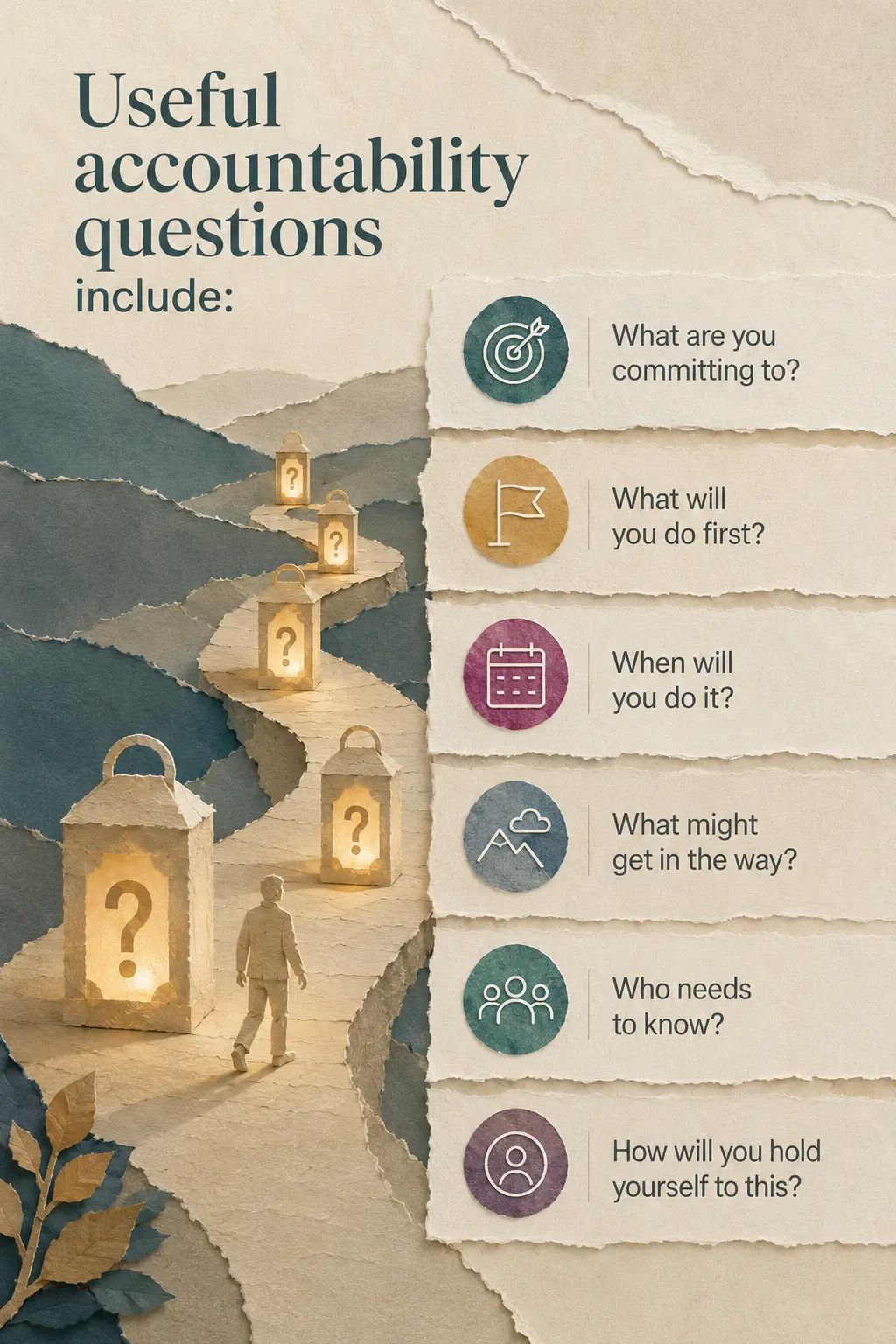
DDI’s research found that leaders who receive effective coaching are 2.7 times more likely to feel accountable for being effective leaders. That matters because accountability is not created by pressure alone.
It is created by clarity, ownership and follow-through.
For leaders, this means we can stop seeing questions as soft.
The right question can be more demanding than advice.
Because it asks the other person to choose.
How Do Questions Improve Team Performance?
Questions improve team performance by creating psychological safety, shared learning and better decision-making.
A team that only waits for instructions will always be limited by the leader’s perspective.
A team that can ask, challenge, reflect and contribute has more thinking power available.
That is where psychological safety becomes important.
Amy Edmondson’s classic research on psychological safety and learning behaviour in work teams found that teams perform better when people feel able to speak up, admit mistakes and discuss concerns. McKinsey also found that consultative and supportive leadership promotes psychological safety, while authoritative leadership can undermine it.
Questions are one of the ways leaders create that climate.
Not performative questions.
Not “any questions?” at the end of a meeting when everyone knows the decision has already been made.
Real questions.
Questions like:
- What are we not seeing?
- What concerns do we need to name?
- What would make this fail?
- Who has a different view?
- What have we learned from this?
- What would make this easier to act on?
These questions help people contribute earlier, before small issues become expensive problems.
For HR and L&D teams, this is important too.
Coaching capability should not be reserved only for senior executives. If managers shape the everyday climate of work, then managers need practical coaching skills.
Gallup has found that managers account for at least 70% of the variance in employee engagement. That is a powerful reminder: the quality of everyday leadership conversations matters.
What Does The Research Say About Coaching At Work?
The research shows that coaching is associated with improvements in performance, wellbeing, coping, work attitudes and goal-directed self-regulation.
That is why coaching should not be seen as a nice extra.
It is a serious leadership capability.
A meta-analysis by Theeboom, Beersma and Van Vianen found that coaching in organisational settings had significant positive effects across several outcomes, including performance and skills, wellbeing, coping, work attitudes and goal-directed self-regulation. The findings are summarised by the Institute of Coaching.
Another workplace coaching meta-analysis by Jones, Woods and Guillaume found positive outcomes for learning and performance, while further coaching research has shown especially strong effects on behavioural change.
This matters because coaching is sometimes misunderstood as simply being supportive.
Support matters, of course.
But coaching is not just about making people feel better.
It is about helping people think better, choose better and act better.
That is what makes questioning so practical.
A good question can:
- Surface the real issue
- Reduce emotional noise
- Increase ownership
- Challenge assumptions
- Clarify action
- Strengthen follow-through
That is not soft.
That is leadership work.
Are Some Questions Better Than Others?
Yes, some questions are better than others because the wording, timing and intention behind a question shape the quality of thinking it creates.
A question can open someone up.
Or shut them down.
For example:
“Why did you do that?”
May sound like blame.
“What was happening for you in that moment?”
Creates more room for reflection.
DDI advises leaders to use open-ended, non-leading questions and to be careful with “why” questions because they can sometimes trigger defensiveness.
That does not mean we should never ask why.
It means we need to ask with care.
Compare these:
The best questions are not always dramatic.
Often, they are simple.
What matters is the mindset behind them.
Curiosity beats interrogation.
Clarity beats cleverness.
Purpose beats performance.
Should Coaching Questions Focus On Problems Or Solutions?
Coaching questions should acknowledge problems but help people move towards solutions, learning and action.
We do not want toxic positivity.
If something is hard, we should be honest about it.
But if a conversation only circles the problem, people can leave feeling more stuck than when they arrived.
Research shared by the Institute of Coaching found that solution-focused questions produced stronger positive effects than problem-focused questions, including higher positive affect, stronger self-efficacy and greater goal progress.
That gives us a practical lesson.
Do not ignore the problem.
But do not live there.
A useful flow might look like this:
- What is happening?
- What impact is it having?
- What matters most here?
- What would a better outcome look like?
- What options do we have?
- What is the next useful step?
This helps people feel heard without becoming trapped.
For leaders, that balance is everything.
People need empathy.
They also need movement.
Which Questions Should Every Coach Master?
Every coach should master questions that build awareness, create accountability, challenge assumptions and encourage action.
You do not need hundreds of questions.
You need a handful you can use well.
Questions That Build Awareness
Awareness questions help people understand what is really going on.
Use them when someone feels stuck, unclear or overwhelmed.
Examples:
- What do you think is really happening here?
- What are you noticing about your reaction?
- What matters most in this situation?
- What feels clear, and what still feels unclear?
- What pattern might be repeating here?
- What are you learning about yourself through this?
These questions slow the conversation down in a good way.
They help the person move from noise to insight.
Questions That Create Accountability
Accountability questions help people move from intention to ownership.
Use them when the conversation needs to become practical.
Examples:
- What are you choosing to do next?
- What will you take responsibility for?
- What is the first step?
- When will you do it?
- What support do you need?
- How will you know you have followed through?
These questions are especially useful because they stop coaching conversations becoming interesting but vague.
Insight is valuable.
Action makes it real.
Questions That Challenge Assumptions
Assumption questions help people test the story they are telling themselves.
Use them when someone seems locked into one interpretation.
Examples:
- What are you assuming here?
- What else could be true?
- What evidence supports that view?
- What evidence might challenge it?
- How might the other person see this?
- If you were less afraid, what would you think?
These questions can be powerful because many problems are made heavier by untested assumptions.
A good question helps people loosen their grip on one version of the story.
Questions That Encourage Action
Action questions help people move forward with confidence.
Use them when the person has enough insight but needs momentum.
Examples:
- What would progress look like this week?
- What is one small step you can take?
- What would make this easier to start?
- What conversation needs to happen?
- What decision are you ready to make?
- What will you do before we speak again?
Action questions work best when they are specific.
“What will you do?” is stronger than “What could you do?”
Could keeps things theoretical.
Will creates commitment.
Questions That Build Confidence
Confidence questions help people reconnect with capability.
Use them when someone feels unsure, discouraged or overwhelmed.
Examples:
- When have you handled something similar before?
- What strengths can you draw on here?
- What do you already know that can help?
- Who could support you?
- What would make this feel more manageable?
- What is one reason you can move forward?
These questions do not pretend everything is easy.
They help people remember they are not powerless.
How Can Leaders Ask Better Questions Tomorrow?
Leaders can ask better questions tomorrow by pausing before giving advice and choosing one question that helps the other person think.
You do not need to overhaul your leadership style overnight.
Start small.
The next time someone brings you a problem, try this three-step approach.
1. Pause Before Solving
Before you answer, take a breath.
Ask yourself:
“Does this person need my answer, or do they need help finding theirs?”
That tiny pause can change the whole conversation.
2. Ask One Thinking Question
Choose one question that opens the conversation.
For example:
- What have you tried so far?
- What do you think is the real issue?
- What outcome are you hoping for?
- What options do you see?
- What would you do if you had to decide now?
You do not need the perfect question.
You need a useful one.
3. Listen Longer Than Feels Comfortable
This is where the real work begins.
Many leaders ask a question, then jump in after three seconds.
Give people time.
Thinking can be quiet before it becomes clear.
A simple phrase can help:
“Take a moment. There’s no rush.”
That one sentence can create space for a better answer.
What Should Leaders Avoid When Asking Coaching Questions?
Leaders should avoid leading questions, stacked questions, judgemental questions and questions asked without listening.
A poor question can look like coaching but still feel controlling.
Avoid these common traps:
The Leading Question
“Don’t you think you should apologise?”
Better:
“What do you think needs repairing here?”
The Stacked Question
“What happened, why did it happen, what were you thinking, and what are you going to do about it?”
Better:
“What happened?”
Then pause.
One question at a time.
The Judgement Question
“Why would you do it like that?”
Better:
“Help me understand your thinking.”
The Fake Question
“Can I make a suggestion?”
This is not wrong, but let’s be honest: it usually means advice is coming.
Better:
“Would it be useful to explore a few options together?”
Great coaching is not just about asking questions.
It is about creating the conditions where honest answers can emerge.
What Does This Mean For HR And L&D Teams?
HR and L&D teams should treat questioning as a core leadership skill, not a niche coaching technique.
If we want better performance conversations, stronger accountability and healthier team cultures, managers need more than feedback models.
They need practice in asking, listening and helping people think.
That includes:
- Coaching skills for line managers
- Practice-based leadership development
- Psychological safety training
- Better one-to-one conversation habits
- Reflection tools after projects and performance moments
- A shared language for ownership and accountability
DDI reports that organisations with strong coaching cultures are 2.9 times more likely to engage and retain top talent and 1.5 times more likely to rank in the top 10% for financial performance.
That does not mean questions magically create business results.
But it does suggest that coaching cultures are connected to the things organisations care about: engagement, retention, accountability and performance.
And culture is built conversation by conversation.
What Does This Mean For Business Owners And Senior Leaders?
Business owners and senior leaders should use questions to distribute thinking instead of becoming the centre of every decision.
This is especially important in growing organisations.
When a business is small, it can feel efficient for every important answer to come from the founder or senior expert.
But over time, that creates dependency.
People wait.
Decisions slow down.
The leader becomes the ceiling.
Question-led leadership helps break that pattern.
Instead of asking, “How do I solve this for them?”
Ask:
“How do I help them think this through well?”
That shift develops capability across the business.
It also helps surface better information. People are more likely to raise risks, ideas and concerns when leaders ask with genuine curiosity.
MIT’s work on question bursts suggests that disciplined questioning can help reframe challenges and generate new ideas quickly.
For senior leaders, this is not just a coaching tool.
It is a strategy tool.
Better questions create better thinking.
Better thinking creates better decisions.
Can Questions Ever Be Unhelpful?
Yes, questions can be unhelpful when they are used to avoid clarity, disguise advice or put pressure on someone without support.
Coaching questions are powerful, but they are not magic.
There are moments when people need:
- Clear direction
- Technical instruction
- Safety guidance
- Immediate decisions
- Honest feedback
- A direct answer
A good leader knows the difference.
If someone is new, inexperienced or dealing with a high-risk issue, they may need more guidance.
If someone is capable but stuck, a question may unlock their thinking.
The art is in choosing the right level of direction for the moment.
A simple test is:
“Would a question help this person think, or would it leave them unsupported?”
That keeps coaching human.
Not rigid.
Not formulaic.
Useful.
How Can We Build A Question-Led Coaching Culture?
We build a question-led coaching culture by making curiosity, reflection and ownership part of everyday leadership.
This does not happen through posters on the wall.
It happens in meetings, one-to-ones, reviews, project debriefs and difficult conversations.
Start with simple habits:
In One-To-Ones
Ask:
- What is going well?
- What feels difficult?
- What support would help?
- What do you want to focus on next?
In Team Meetings
Ask:
- What are we learning?
- What are we missing?
- What needs a decision?
- What should we stop doing?
In Performance Conversations
Ask:
- What are you proud of?
- What has been challenging?
- What would help you improve?
- What commitment are you making?
In Project Reviews
Ask:
- What worked?
- What did we learn?
- What would we do differently?
- What should we carry forward?
These questions are not complicated.
That is the point.
A coaching culture is not built by having the fanciest questions.
It is built by asking useful questions consistently, then listening well enough for the answers to matter.
Start Asking Better Questions Today
Great coaches do not create change by having all the answers.
They create change by helping others discover their own.
That does not mean leaders should never advise, guide or direct. Of course not. Leadership still requires clarity and courage.
But when advice becomes the default, we can accidentally reduce ownership.
A better question can open the door to better thinking.
Better thinking creates better choices.
Better choices create better action.
So next time someone brings you a problem, pause before you solve.
Ask one thoughtful question.
Then listen.
Because sometimes the most powerful leadership move is not to give the answer.
It is to help someone find the answer they are ready to own.
FAQs About Powerful Coaching Questions
Why are coaching questions more effective than advice?
Coaching questions are often more effective because they help people generate their own insight and commitment. Advice can be useful, but questions usually create more ownership because the person has had to think, choose and articulate the answer themselves.
What makes a question powerful?
A powerful question is clear, open, purposeful and non-leading. It helps someone reflect, see a situation differently or decide what action they will take. The best questions are usually simple, not clever.
Can leaders use coaching questions without formal coaching training?
Yes. Leaders do not need to become professional coaches to use a coach-like approach. Simple questions such as “What options have you considered?” or “What would progress look like?” can immediately improve everyday leadership conversations.
How do questions improve accountability?
Questions improve accountability by helping people define their own actions. When someone says what they will do, when they will do it and why it matters, they are more likely to own the outcome.
Are coaching questions always better than giving advice?
No. Sometimes people need clear direction, instruction or expertise. Coaching questions are most useful when the goal is to develop thinking, ownership and confidence. Great leaders know when to ask and when to tell.
What is a good coaching question to start with?
A strong starting question is: “What do you think is really going on?” It helps the person pause, reflect and move beyond the surface issue.
- Great questions help people think for themselves, which often creates stronger ownership than advice.
- Research on self-generated learning shows that people remember more when they create answers themselves.
- Coaching questions support autonomy, reflection, accountability and behaviour change.
- Leaders often default to advice because it feels fast, useful and tied to expertise.
- Better questions can improve psychological safety by helping people speak up, reflect and contribute.
- The best coaching questions are clear, curious, non-leading and connected to action.

Trayton Vance
Trayton Vance is the Founder and Managing Director of Coaching Focus Group, one of the UK’s leading leadership coaching consultancies working with clients such as McDonalds, Beats by Dre, Paramount and many more.
Coaching Focus Group
Specialists in leadership coaching, workplace coaching programmes, and building coaching cultures that stick.



You might be interested in...


Employee Engagement Series


