


Motivation Theory: What Really Drives Effort at Work


Motivation is the engine behind effort, persistence, learning, creativity, and performance. It’s also the thing leaders routinely oversimplify into: “Pay them more,” “Push harder,” “Pump them up,” or “Hire better people.” Those levers sometimes work – briefly - but they’re not the whole mechanism.
This article lays out the major motivation theories, the models they introduced, and the research that supports (and challenges) them and then turns it into practical leadership moves.
1) Start with a clean definition
A useful working definition:
Motivation = direction + intensity + persistence of effort.
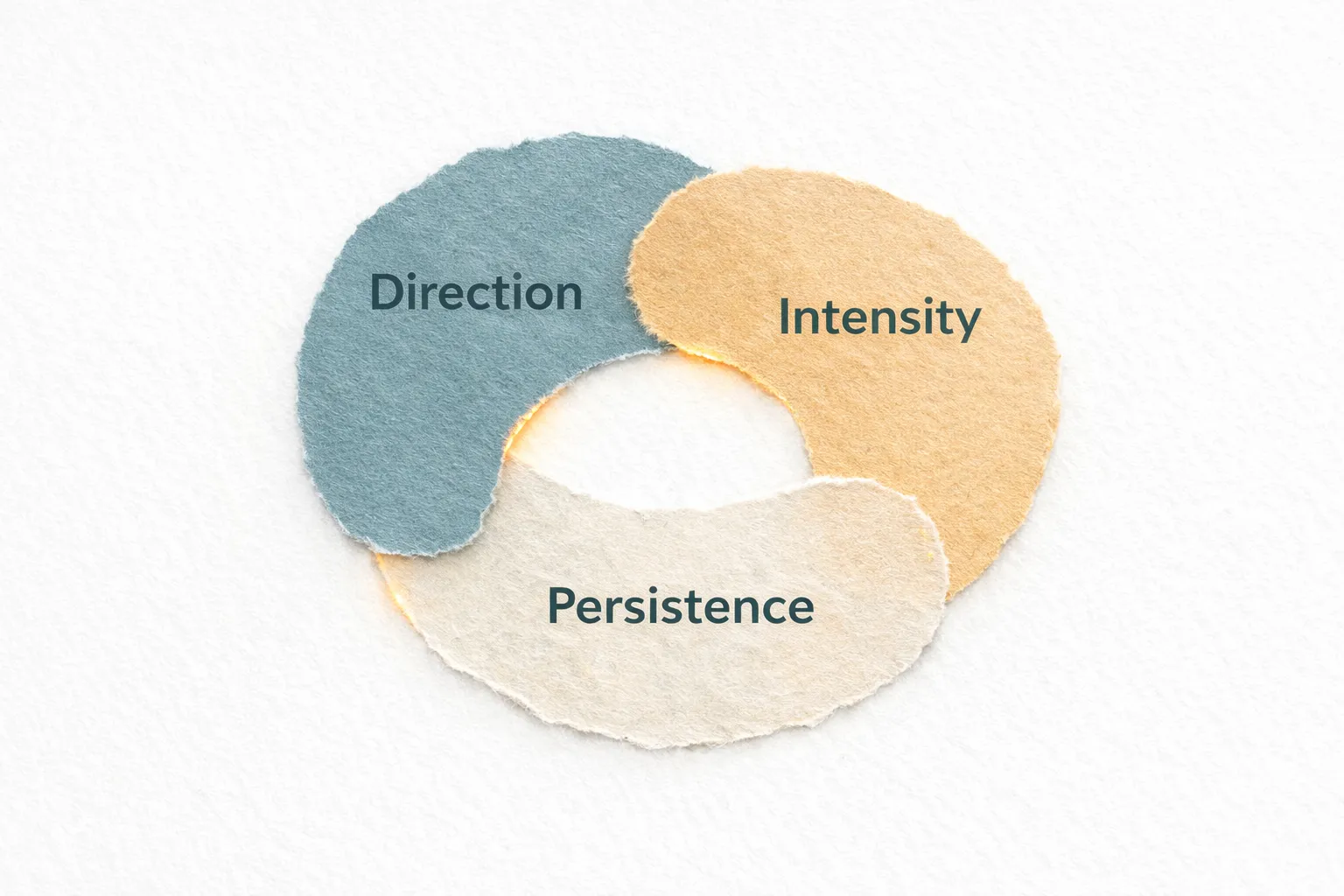
So, motivation theory tries to explain:
- Why people choose a behaviour (direction)
- How hard they work at it (intensity)
- How long they keep going (persistence)
Most workplace “motivation problems” are failures in one of these:
- People don’t believe the goal matters (value problem)
- People don’t believae they can succeed (capability problem)
- People don’t trust the system will reward the effort (fairness/credibility problem)
- People are exhausted or overloaded (capacity/energy problem). The physical environment plays a bigger role in energy and focus than many leaders realise. Even something as simple as a clean office can boost wellbeing.
Different theories explain different parts.
2) The most useful “big” modern framework: Self-Determination Theory (SDT)
If you only learn one motivation model that holds up across contexts, make it Self-Determination Theory.
Core SDT claim
Humans are most sustainably motivated when three psychological needs are supported:
- Autonomy (I have choice/volition)
- Competence (I can improve and succeed)
- Relatedness (I belong; I’m respected)
This isn’t “let people do whatever they want.” SDT is about the experience of choice and ownership, even inside constraints.
Intrinsic vs extrinsic (and the internalisation continuum)
SDT doesn’t say extrinsic motivators are always bad; it says the quality of motivation matters.
A key SDT sub-model, Organismic Integration Theory (OIT), maps motivation from:
- Amotivation → external regulation → introjected (guilt/ego) → identified (personally important) → integrated (aligned with identity) → intrinsic
Leaders can’t force intrinsic motivation, but they can help people internalise the why.
Research: rewards can backfire—depending on how you use them
A major meta-analysis of 128 studies found tangible, expected rewards can reduce intrinsic motivation for interesting tasks, especially when the reward feels controlling.
Translation for leaders:
Incentives aren’t “evil.” But if your reward design screams “Do this for me or else,” you’ll get compliance, not ownership.
3) Goal-Setting Theory: motivation needs a target (but not just any target)
Goal-Setting Theory (Locke & Latham) is one of the most practically validated workplace theories. It shows that, in general, specific and challenging goals improve performance—when paired with feedback and commitment.
Why goals work (mechanisms)
Goals tend to:
- Focus attention
- Energise effort
- Increase persistence
- Drive strategy/learning
Moderators (when goals fail)
Goals can backfire when:
- People don’t have capability/resources
- Goals encourage gaming/shortcuts
- The goal is too complex without learning time
- The climate punishes mistakes, so people hide problems
Leader move: Pair performance goals with learning goals when the task is new/complex.
4) Expectancy Theory: “Will my effort actually pay off?”
Expectancy Theory (Vroom) says motivation depends on three beliefs:
- Expectancy: “If I try, can I perform?”
- Instrumentality: “If I perform, will I get outcomes?”
- Valence: “Do I value those outcomes?”
This model is brutally diagnostic. If motivation is low, at least one of the three is broken.
Common workplace failures
- Expectancy breaks: unclear role, weak training, constant priority whiplash
- Instrumentality breaks: “performance doesn’t matter here,” favouritism, empty promises
- Valence breaks: rewards people don’t care about, or recognition that feels fake
Leader move: Don’t “pep talk” someone whose instrumentality is broken. Fix the system credibility.
5) Job Characteristics Model: motivation built into the work itself
Hackman & Oldham’s Job Characteristics Model (JCM) argues that certain job features create “critical psychological states” that increase internal motivation and satisfaction.
The five core job dimensions
- Skill variety
- Task identity
- Task significance
- Autonomy
- Feedback
When these are present, people experience more meaning, responsibility, and knowledge of results—fuel for sustained motivation.
Leader move: If you can’t pay more, redesign the job:
- Bundle tasks to increase identity
- Make impact visible (significance)
- Increase decision latitude (autonomy)
- Tighten feedback loops (feedback)
6) “Needs” theories: helpful, but easy to misuse
Maslow’s hierarchy (classic, often oversimplified)
Maslow proposed that human needs range from basic to growth-oriented. His original work is nuanced and often misrepresented as a rigid staircase.
Practical value: It reminds leaders that stressors (security, belonging) crush higher-level performance.
ERG Theory (Alderfer): a tighter update
Alderfer condensed needs into:
- Existence
- Relatedness
- Growth
…and argued you can pursue multiple needs at once, and frustration in growth can increase focus on lower needs.
Leader move: When someone’s “growth” is blocked (no development), don’t be shocked when they start caring a lot more about pay, conditions, or title.
McClelland’s Needs Theory (Acquired Needs)
McClelland emphasised learned dominant drivers:
- Need for achievement
- Need for affiliation
- Need for power
Leader move: Match roles and recognition to dominant drivers (e.g., achievement-focused people want clear scoreboards; affiliation-focused people want harmony and belonging; power-focused people want influence and responsibility).
7) Fairness and justice: motivation dies fast when people feel screwed over
Equity Theory (Adams)
People compare their input/output ratio to others. Perceived inequity creates tension and motivates attempts to restore balance (reduce effort, ask for more, leave, etc.).
Leader reality check:
You can’t “culture” your way out of perceived unfairness. If pay, workload, or recognition is wildly inconsistent, motivation will rot.
8) Reinforcement theory: behaviour follows consequences (but don’t confuse compliance with motivation)
Operant conditioning / reinforcement theory (Skinner) explains how consequences shape behaviour—reinforcement increases behaviour, punishment decreases it.
This is incredibly useful for:
- Habit formation
- Safety behaviours
- Process compliance
- Sales activity targets
But it’s limited for:
- Creativity
- Complex problem-solving
- Long-term ownership
Leader move: Use reinforcement for repeatable behaviours, but don’t expect it to produce passion, innovation, or loyalty.
9) Self-efficacy: confidence changes effort and persistence
Bandura’s self-efficacy theory shows that belief in capability predicts whether people start, how hard they try, and how long they persist.
Leader move: Motivation often rises fastest when you:
- Shrink the task into early wins
- Provide modelling (show examples)
- Give coaching feedback tied to strategy (not personality)
- Remove repeated failure loops
10) Attribution theory: what people think caused outcomes shapes future motivation
Weiner’s attribution theory says people explain success/failure using dimensions like:
- locus (internal/external)
- stability (stable/unstable)
- controllability (controllable/uncontrollable)
If someone attributes failure to “I’m just bad at this” (internal, stable, uncontrollable), motivation collapses.
If they attribute it to “wrong approach; I can change strategy” (controllable), persistence rises.
Leader move: Coach the explanation, not just the behaviour:
- “What did you try?”
- “What will you do differently next time?”
- “What’s controllable here?”
11) Regulatory Focus Theory: different people are motivated by different frames
Regulatory Focus Theory (Higgins) distinguishes:
- Promotion focus (growth, gains, advancement)
- Prevention focus (safety, responsibility, avoiding loss)
Leader move: When you pitch change:
- Promotion folks respond to opportunity and upside.
- Prevention folks respond to risk reduction and reliability.
If you use only one frame, you’ll “motivate” half your team and alienate the other half.
Putting it together: a leader’s Motivation Diagnostic (fast and effective)
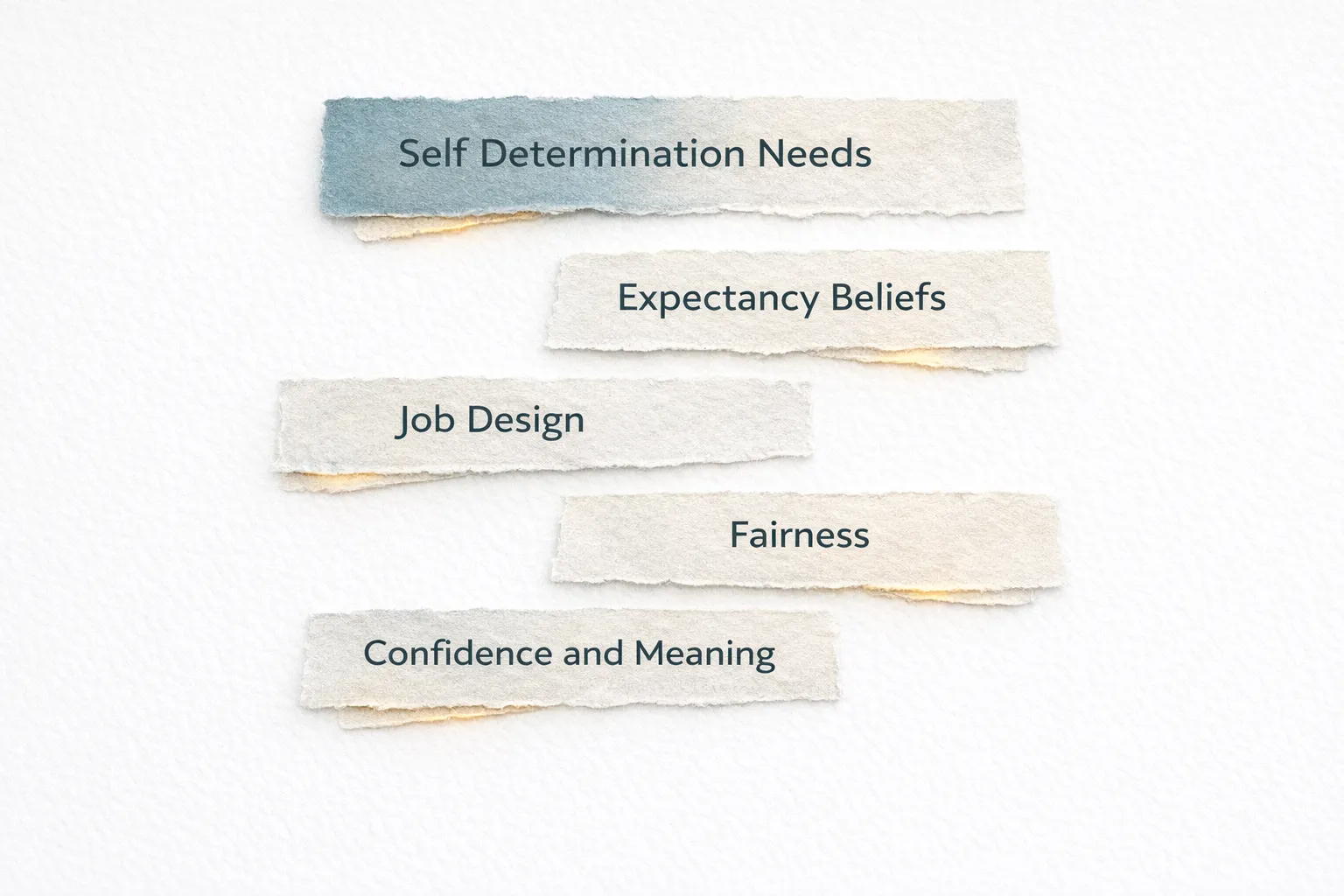
When motivation is low, don’t guess. Diagnose with these lenses:
A) SDT needs check (quality of motivation)
- Autonomy supported?
- Competence building?
- Relatedness/respect present?
B) Expectancy check (belief system)
- Can they do it? (expectancy)
- Will it matter? (instrumentality)
- Do they care? (valence)
C) Job design check (work itself)
- Autonomy, feedback, significance, variety, identity?
D) Fairness check (equity)
- Do they perceive imbalance compared to peers?
E) Confidence + meaning check
- Self-efficacy strong enough to persist?
- Are they attributing setbacks in a controllable way?
The blunt leadership truth about “motivation programs”
Most “motivation” initiatives fail because they try to add inspiration on top of:
- unclear goals,
- broken systems,
- unfair workload,
- weak management,
- no feedback loops.
If you want real motivation, fix the environment that kills it.
Quick “best bets” backed by theory
If you want high ROI interventions that align with the strongest models:
- Increase autonomy without lowering standards (SDT + JCM)
- Build competence fast with tight feedback loops (SDT + self-efficacy)
- Set specific, challenging goals + feedback (Goal-setting theory)
- Make effort to outcome links credible (Expectancy theory)
- Fix fairness hotspots (Equity theory)
- Use rewards carefully—avoid “controlling” signals (SDT reward research)
Looking for Coaching Resources?
If you're looking for a consistent array of coaching resources, try out our Coaching Resource Hub. You will not be dissapointed.
FAQs About Motivation Theory
What actually motivates people at work according to research?
Sustained motivation comes from belief and design, not pressure. People work harder and longer when they feel choice in how they work, believe they can succeed, trust the system to reward effort, and see meaning in the work itself.
Why do bonuses and incentives sometimes reduce motivation?
Because they can feel controlling. When rewards signal “do this or else,” people comply but stop taking ownership. Research shows this is especially damaging for interesting or complex work.
How can leaders tell what is really causing low motivation?
By diagnosing, not guessing. Low motivation usually comes from broken belief in success, unfair systems, unclear goals, lack of energy, or poor job design, not from attitude or laziness.
What is the difference between intrinsic and extrinsic motivation?
Extrinsic motivation is driven by external rewards or pressure. Intrinsic motivation comes from enjoyment or personal meaning. Leaders cannot force intrinsic motivation, but they can help people internalise the why behind the work.
Why do people stop trying even when goals are clear?
Because confidence and credibility collapse. If people do not believe effort leads to results, or they repeatedly fail without support, persistence drops fast regardless of how clear the target is.
What are the most effective ways to increase motivation without paying more?
Redesign the work. Increase autonomy. Tighten feedback loops. Make impact visible. Build early wins to restore confidence. Fix fairness gaps. These moves consistently outperform motivation programmes or speeches.
Motivation Theory: What Actually Drives Human Effort (and What Leaders Get Wrong)
Motivation is not about hype, pressure, or bigger bonuses. It is about belief, fairness, energy, and meaning, all designed into the work itself. When leaders stop trying to fix motivation with pep talks and start fixing the systems, roles, and signals that drain it, effort and ownership rise fast.

Trayton Vance
Trayton Vance is the Founder and Managing Director of Coaching Focus Group, one of the UK’s leading leadership coaching consultancies working with clients such as McDonalds, Beats by Dre, Paramount and many more.
Coaching Focus Group
Specialists in leadership coaching, workplace coaching programmes, and building coaching cultures that stick.



You might be interested in...


Employee Engagement Series
.webp)


