


Listening vs Noticing: The Hidden Skill Great Coaches and Leaders Master


We often talk about listening as the foundation of great coaching. And yes, listening matters because it is where connection begins. But listening alone will not get you far. If all you do is tune into words, you risk missing the real conversation happening underneath.
Coaching is not a data exchange. It is a moment-to-moment human exchange. It is not just about what is said. It is about what is shown, felt, and sensed. The magic happens when you move beyond listening and step into noticing.
When you only listen, you gather information. When you notice, you gather insight.
The Difference Between Listening and Noticing
Listening is what your ears do. Noticing is what your whole being does.
Listening captures sound. Noticing captures meaning.
Listening can be passive. You hear, nod, respond. Noticing is active. You sense, interpret, and adapt.
A coach who listens might catch a client saying, “I’m fine.”
A coach who notices will pick up the tiny pause before “fine,” the tightness in the jaw, the flicker in the eyes, and know something is not fine at all.
This deeper awareness becomes your compass. It helps you decide whether to challenge, stay silent, shift energy, or ask a question that cuts through the noise. Noticing multiplies the intelligence in the room.
The Full Body of Noticing
Noticing doesn’t happen through the ears alone. It’s a full-body practice. A great coach learns to notice with:
- The ears – for tone, rhythm, and pace. Not just what is said, but how.
- The eyes – for movement, stillness, micro-expressions, and shifts in energy.
- The head – for patterns, inconsistencies, and the stories being told (and avoided).
- The heart – for empathy, resonance, and emotional truth.
- The gut – for instinct, intuition, and the quiet knowing that logic can’t always explain.
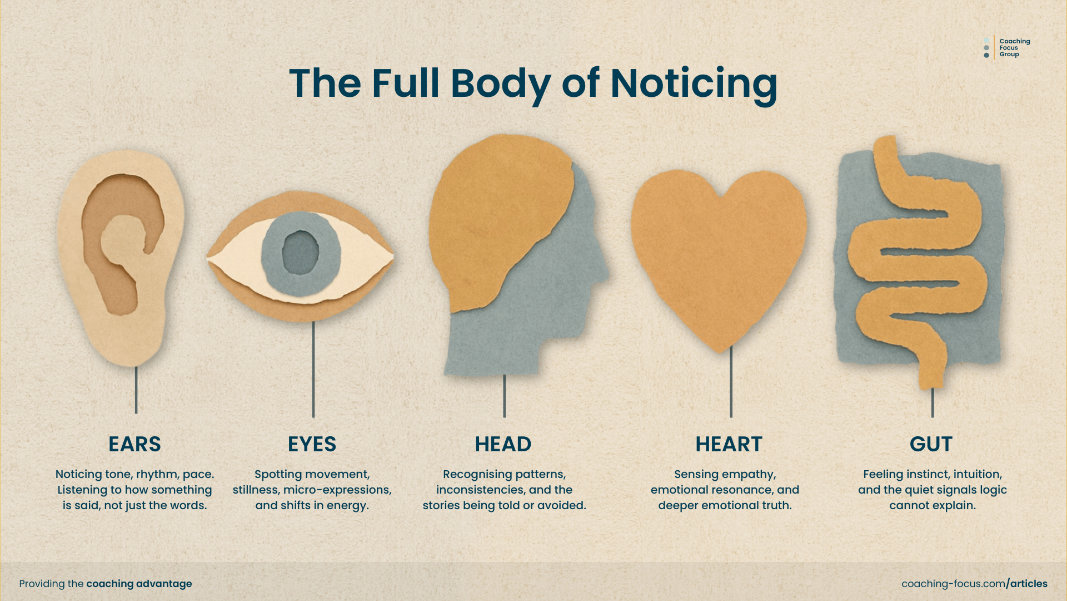
When all of these channels are tuned in, you stop processing data and start reading the room. You’re no longer reacting — you’re responding from a deeper intelligence.
The Four Arenas of Noticing
A skilled coach or leader doesn’t just notice in one direction. True awareness expands across four key arenas: yourself, the other person, the relationship, and the context.
1. Noticing Yourself
It begins with you. Self-awareness is the anchor of great coaching.
Notice your own body. Are you tense, rushed, distracted? Are you genuinely present or already planning your next question? Your internal state quietly shapes the quality of every conversation you have.
Notice your assumptions. Are you judging, rescuing, fixing, or trying to impress? These habits can cloud your ability to see clearly. When you notice them early, you can step back and reset.
Self-noticing is not self-criticism. It’s self-honesty. It’s catching yourself in real time and choosing how you want to show up.
2. Noticing the Other Person
Next, turn your attention outward. What are you picking up from the other person beyond their words?
Notice their breathing, posture, gestures, and micro-expressions. Are they leaning in or pulling back? Are they energised or deflated? Does their story flow easily, or does it stumble when they hit certain topics?
The body often tells the truth before the mouth does. A sharp coach knows how to read those signals gently, never to expose, but to invite awareness.
3. Noticing the Relationship
Every coaching conversation has an invisible dynamic - the relationship. It’s the emotional field that holds you both.
Notice how the space between you feels. Is it open or guarded? Supportive or strained? Equal or subtly hierarchical?
Perhaps you’ve both slipped into a pattern — you ask, they please; you probe, they defend. Noticing this dynamic allows you to name it, shift it, or use it as data.
Strong relationships are built not on perfect communication, but on mutual awareness. When a coach can sense the tension or trust in the space, they can navigate it with grace.
4. Noticing the Context
Finally, zoom out. Context is everything.
What system does this person sit within? What pressures or expectations surround them? What’s unspoken but shaping the story?
Context gives colour to the conversation. A leader hesitating to delegate may not be “control-obsessed” but operating in a culture that punishes mistakes. A team member resisting feedback might not be “defensive” but protecting themselves from a history of harsh criticism.
When you notice context, you widen the frame. You stop taking things at face value and start coaching the whole system, not just the symptom.
Why Noticing Matters
Noticing elevates coaching from transactional to transformational. It helps you access multiple layers of information — intellectual, emotional, physical, and systemic.
It sharpens your intuition.
It deepens your empathy.
It strengthens your judgment.
And most importantly, it informs what you do next. Whether that’s asking a piercing question, holding a silence, or offering an observation that lands exactly where it’s needed.
A conversation guided by noticing feels different. It slows down. It breathes. It moves from surface talk to real talk.
Practising the Art of Noticing
Like any skill, noticing grows with practice. Here are a few ways to build the muscle:
- Pause often. Create space to check in with what you’re sensing, not just hearing.
- Reflect afterwards. After a conversation, ask yourself: What did I notice? What did I miss?
- Use your body as data. That tightening in your chest or the lightness in your stomach might be telling you something important.
- Stay curious. Notice without rushing to interpret. Sometimes the noticing itself is the coaching.
Over time, you’ll find your awareness expanding. You’ll catch subtler shifts. You’ll speak less, but say more.
The Coach Who Notices
A coach who notices isn’t trying to impress or fix. They’re simply awake to themselves, to others, to the moment. They listen with their ears, yes. But they also see with their eyes, feel with their heart, think with their head, and trust their gut.
That combination doesn’t just make a better coach. It makes a wiser human. So next time you sit down with someone, pause before you dive into questions. Don’t just listen. Notice.
Notice everything and let what you see, hear, and feel guide the conversation that truly needs to happen.
Want to see this skill in action?
Read the Skill in Action box below.
FAQs About Listening vs Noticing
1. What is the difference between listening and noticing?
Listening is about taking in the words someone says. Noticing is about sensing everything else — tone, posture, emotion, energy, and what’s left unsaid. One gathers information. The other gathers insight.
2. Why is noticing so important in coaching or leadership?
Noticing reveals the real story. It helps you understand what’s really going on for the other person so you can respond with more empathy, clarity, and impact.
3. What should I be noticing in a conversation?
Pay attention to tone, pace, body language, shifts in energy, your own reactions, and the overall dynamic between you and the other person. All of these offer clues.
4. How can I get better at noticing?
Slow down. Pause often. Check in with your body. Stay curious. Reflect on what you picked up after the conversation. The more you practise, the more naturally noticing will come.
Summary: Listening vs Noticing
Listening helps you hear the words. Noticing helps you understand the truth beneath them. This article explores how great coaches and leaders move beyond simply hearing and start tuning into tone, energy, body language, and context. The key insight is simple: when you notice more, you coach at a deeper, more human level. That’s where real transformation starts.

Trayton Vance
Trayton Vance is the Founder and Managing Director of Coaching Focus Group, one of the UK’s leading leadership coaching consultancies working with clients such as McDonalds, Beats by Dre, Paramount and many more.
Coaching Focus Group
Specialists in leadership coaching, workplace coaching programmes, and building coaching cultures that stick.



You might be interested in...


Employee Engagement Series


