


Coaching Through Conflict: How Leaders Can Turn Workplace Tension Into Growth


Coaching Through Conflict (noun)
A coaching approach that helps people navigate disagreements constructively through self awareness, effective communication, and solution focused conversations.
Conflict at work is inevitable. The way we handle it is not.
When conflict is ignored, it drains energy, damages relationships, and slows progress. When it is handled well, it can strengthen trust, spark better ideas, and help teams work together more effectively.
That is where coaching through conflict comes in.
Rather than rushing to solve problems for people, coaching helps individuals think clearly, regulate emotions, understand different perspectives, and find constructive ways forward. Research shows coaching can improve self efficacy, resilience, psychological capital, and behavioural change. These are all capabilities that help people navigate conflict more successfully.
But there is a catch.
Many organisations still treat conflict as something to suppress, avoid, or escalate to HR. The most effective organisations take a different approach. They equip leaders with coaching skills that help people address tensions early, before they become bigger problems.
So what does coaching through conflict actually look like in practice?
What Is Coaching Through Conflict?
Coaching through conflict is a structured approach that helps people navigate disagreements, improve relationships, and move towards constructive solutions.
Unlike mediation, coaching typically focuses on one individual at a time. The goal is not to determine who is right or wrong. The goal is to help someone think more clearly, understand their options, and choose their next steps with confidence.
This distinction matters.
A coach is not an investigator. They are not a judge. They are not there to provide legal advice or make decisions for others.
Instead, they create a safe space where people can reflect, explore different perspectives, and prepare for productive conversations.
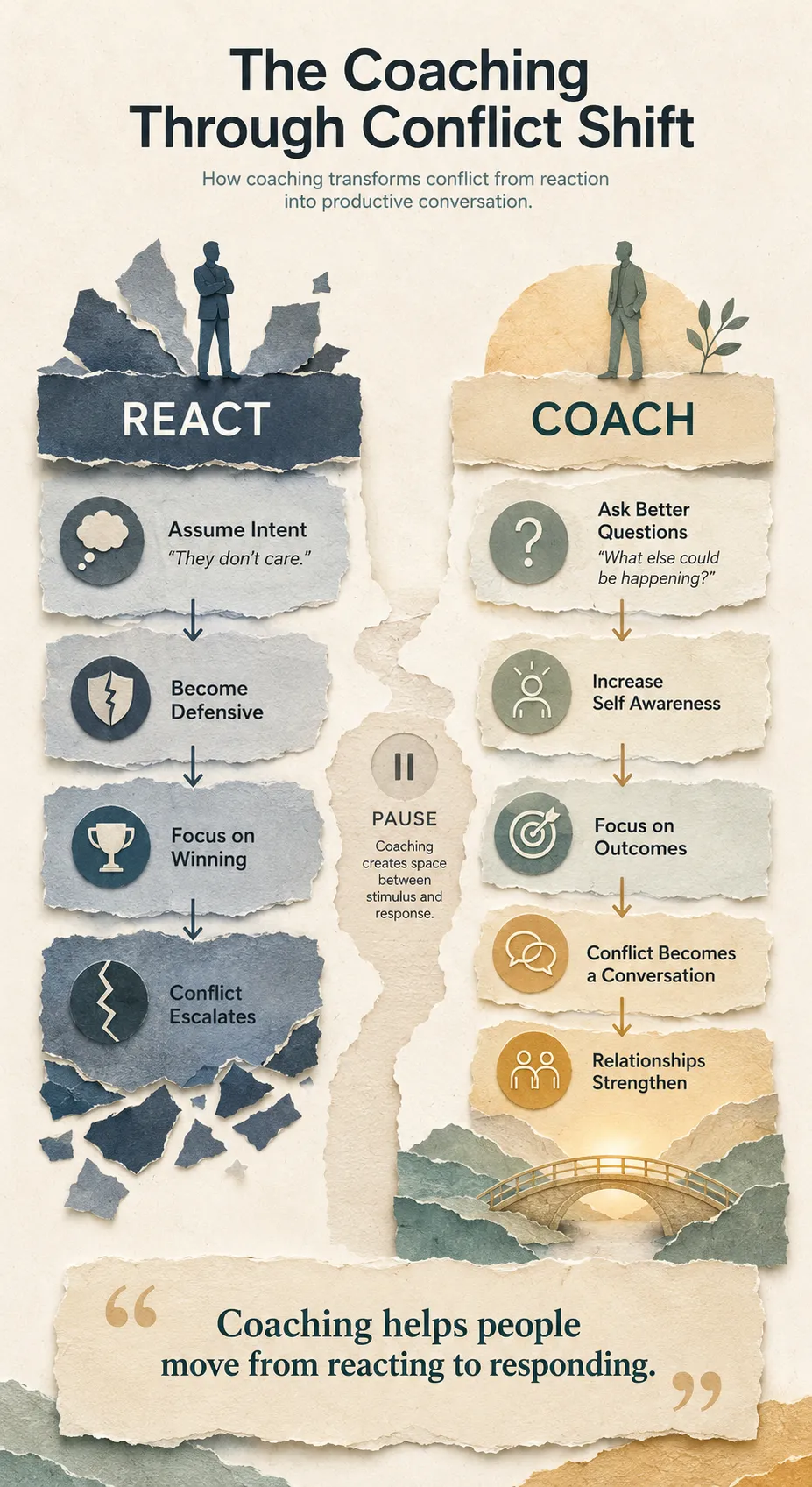
At its heart, coaching through conflict helps people move from reacting to responding.
"Coaching helps people move from reacting to responding."
Why Does Workplace Conflict Happen?
Workplace conflict happens when differences in goals, expectations, communication styles, or perceptions create tension between people.
It is also far more common than many leaders realise. Research commissioned by Acas found that around one in four UK employees experienced workplace conflict over a 12 month period. That means conflict is not an occasional workplace challenge. It is a regular part of organisational life.
Most conflict is not caused by bad intentions.
It often starts with misunderstandings, unclear expectations, competing priorities, or assumptions about another person’s motives. Over time, these small issues can grow into larger disputes if they are left unresolved.
Research has consistently shown that unresolved relationship conflict can reduce both team performance and job satisfaction. The longer conflict is allowed to linger, the greater the impact it can have on individuals, teams, and organisational culture.
That is why early intervention matters.
The sooner people gain clarity, the easier it becomes to prevent conflict from escalating.
How Can Coaching Help Reduce Conflict?
Coaching helps people develop the skills and mindset needed to handle conflict more effectively.
The need for these skills has never been greater. Research by De Dreu and Weingart found that relationship conflict is consistently associated with lower team performance and lower job satisfaction. When conflict becomes personal, rather than focused on tasks or ideas, organisations often pay the price through reduced collaboration and engagement.
The evidence for coaching is encouraging. Multiple meta analyses have found that workplace coaching delivers a moderate positive impact across areas such as performance, goal attainment, resilience, and behaviour change. Rather than offering a quick fix, coaching helps people develop lasting capabilities they can apply long after a conflict has been resolved.
When people feel threatened, frustrated, or misunderstood, their ability to think objectively often decreases. They become defensive. They make assumptions. They focus on protecting themselves rather than solving the problem.
Coaching interrupts this cycle.
A skilled coach helps individuals:
- Recognise emotional triggers
- Challenge unhelpful assumptions
- Explore alternative perspectives
- Clarify their goals
- Improve communication
- Prepare for difficult conversations
- Build confidence before taking action
Instead of asking, “How do I win this argument?”, coaching encourages a more productive question:
“What outcome am I trying to achieve?”
That shift can transform the entire conversation.
Why Is Self Awareness So Important During Conflict?
Self awareness helps people understand how their own behaviour contributes to workplace tension.
Research suggests this is one of the most valuable outcomes of coaching. A 2023 meta analysis by Nicolau and colleagues found coaching can significantly improve self efficacy, resilience, and psychological capital. These qualities help individuals stay composed under pressure and approach difficult conversations more constructively.
Most people can easily identify what the other person is doing wrong.
Few stop to consider their own impact.
Most people can easily identify what the other person is doing wrong.Few stop to consider their own impact.
Coaching creates space for honest reflection without blame or judgement. This allows individuals to recognise patterns they may not have noticed before.
For example:
Sarah believes her manager constantly dismisses her ideas.
During coaching, she reflects on recent meetings and realises she often presents concerns without proposing solutions. Her manager, meanwhile, values proactive problem solving.
This does not mean Sarah’s concerns are invalid.
It simply reveals a communication gap that neither party had fully understood.
Once that insight emerges, new possibilities become available.
What Does Coaching Through Conflict Look Like In Practice?
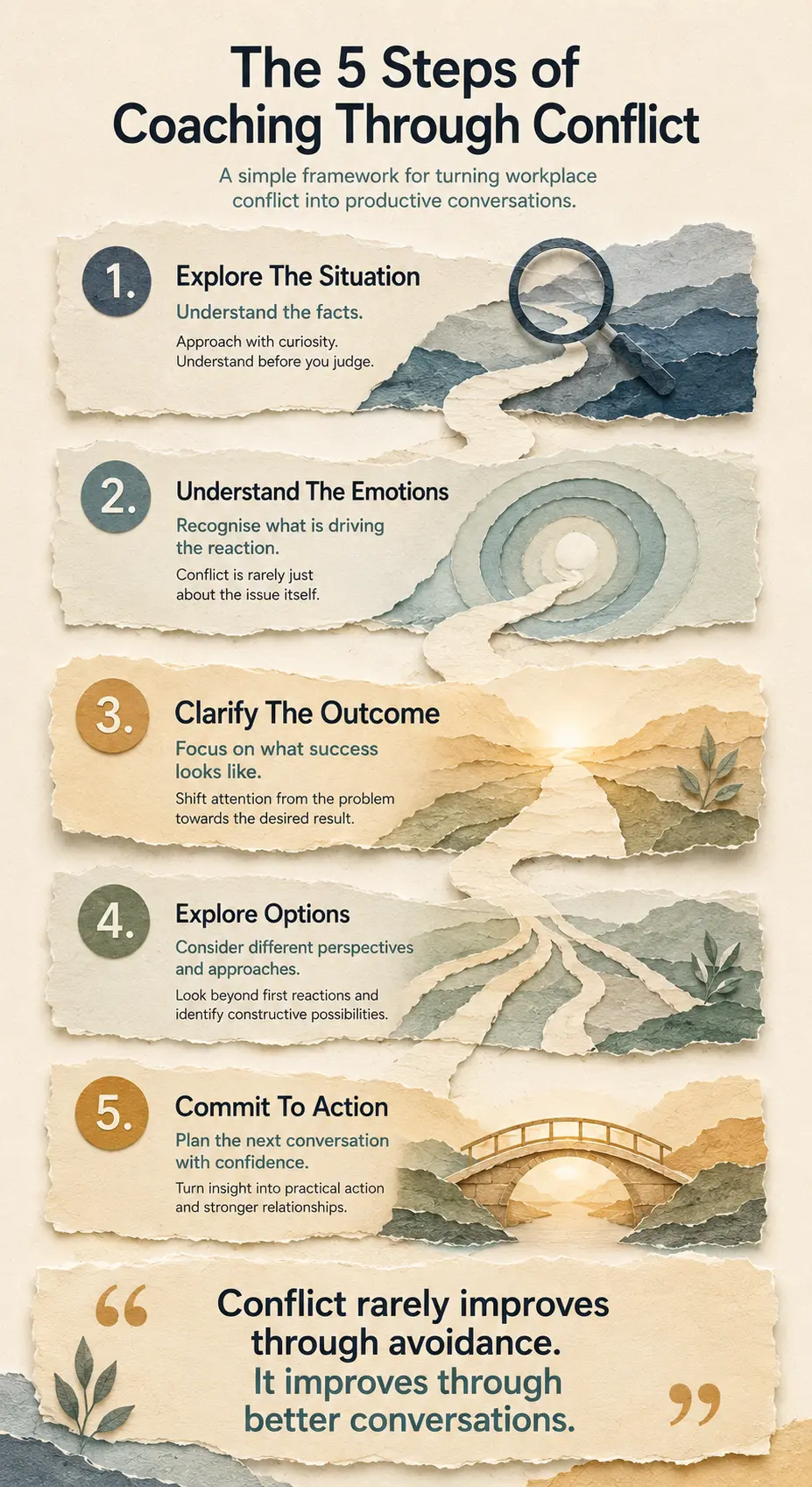
Coaching through conflict follows a structured but flexible process.
A typical conversation might include:
Step 1: Explore What Is Happening
The coach helps the individual describe the situation objectively.
Questions might include:
- What happened?
- Who is involved?
- What impact is this having?
- What assumptions are you making?
The goal is to separate facts from interpretations.
Step 2: Understand The Emotional Response
Conflict is rarely just about the issue itself.
It is often about how people feel.
The coach explores:
- What emotions are present?
- What feels threatened?
- What is driving the strongest reaction?
This helps reduce emotional intensity and increase self awareness.
Step 3: Clarify The Desired Outcome
Many people enter conflict focused on proving a point.
Coaching shifts attention towards outcomes.
Questions might include:
- What would success look like?
- What relationship do you want after this conversation?
- What matters most here?
This creates greater clarity and purpose.
Step 4: Explore Options
The coach encourages curiosity and creativity.
Possible questions include:
- What approaches have you not considered?
- How might they see the situation?
- What is one small step you could take?
The focus is on expanding possibilities rather than prescribing solutions.
Step 5: Prepare For Action
The final stage turns insight into action.
This may involve:
- Rehearsing a conversation
- Testing language
- Anticipating challenges
- Building confidence
People often leave with a clear plan and a stronger sense of control.
What Makes Coaching More Effective Than Giving Advice?
Coaching helps people discover solutions they are more likely to implement.
Research suggests this is where coaching delivers some of its greatest value. A 2023 meta analysis found coaching had one of its strongest effects on behavioural outcomes. In simple terms, coaching does more than create awareness. It helps people turn insight into action.
But advice often creates dependence.
Coaching creates ownership.
When individuals generate their own insights and actions, they are more committed to following through. People do not simply understand what to do.
They become more willing to do it.
What Mistakes Should Leaders Avoid During Conflict?
Leaders should avoid trying to fix problems too quickly.
This is one of the most common mistakes.
When tensions rise, many managers jump straight into solution mode. They interrupt. They advise. They assume.
Unfortunately, this often leaves people feeling unheard.
Other common mistakes include:
- Taking sides too early
- Making assumptions about intent
- Avoiding difficult conversations
- Focusing on blame
- Ignoring emotions
- Delaying action until conflict escalates
A coaching approach helps leaders slow down, ask better questions, and understand the situation more fully before responding.
When Is Coaching Not The Right Approach?
Coaching is not appropriate for every workplace conflict.
It works best when the issue involves communication breakdowns, interpersonal tension, role clarity, feedback challenges, or relationship repair.
Some situations require formal processes.
Examples include:
- Harassment
- Discrimination
- Bullying
- Retaliation
- Safeguarding concerns
- Serious misconduct
- Violence or threats
In these cases, organisations must follow appropriate HR, legal, or safeguarding procedures.
Coaching can sometimes support individuals alongside these processes, but it should never replace them.
How Can Organisations Build A Coaching Culture Around Conflict?
Organisations can build a coaching culture by helping leaders address conflict early and constructively.
Evidence suggests that isolated interventions rarely create lasting change. Organisations achieve better outcomes when coaching forms part of a wider conflict management strategy that includes leadership development, early intervention, mediation, and psychological safety.
For example, East Lancashire Hospitals NHS Trust reported mediation resolution rates above 90% after introducing a broader approach to workplace conflict. The lesson is clear. When organisations invest in conflict capability across the business, people are better equipped to resolve challenges before they escalate.
This might include:
- Coaching skills training for managers
- Early resolution processes
- Mediation services
- Clear workplace policies
- Leadership development programmes
- Psychological safety initiatives
When these elements work together, conflict becomes easier to address before relationships break down.
The result is not the absence of conflict.
It is the presence of healthier conversations.
What Is The Future Of Coaching Through Conflict?
The future of coaching through conflict is likely to focus on accessibility, prevention, and capability building.
Research increasingly points towards the importance of psychological capital, which includes hope, resilience, optimism, and self efficacy. Studies suggest coaching can strengthen these qualities, helping people remain constructive during challenging conversations and periods of uncertainty.
As organisations place greater emphasis on wellbeing, psychological safety, and healthy workplace relationships, these capabilities are becoming increasingly valuable.
Research continues to show that coaching strengthens many of the capabilities people need to navigate workplace tension successfully, including resilience, emotional regulation, self efficacy, and behavioural change.
The question is no longer whether conflict will happen.
The question is whether your people have the skills to handle it well.
Coaching helps them develop those skills.
And when people learn how to navigate conflict with confidence, curiosity, and clarity, everybody benefits.
Ready To Transform Conflict Into Growth?
Conflict does not have to damage relationships, derail performance, or create division.
With the right coaching approach, difficult conversations become opportunities to strengthen trust, deepen understanding, and move forward together.
Because the most successful organisations are not the ones that avoid conflict.
They are the ones that learn how to coach through it.
"The most successful organisations are not the ones that avoid conflict. They are the ones that learn how to coach through it."
Research Referenced
- Acas Workplace Conflict Survey
- De Dreu & Weingart – Relationship Conflict and Team Outcomes
- Nicolau et al. (2023) Meta Analysis of Workplace Coaching Outcomes
- de Haan & Nilsson (2023) Coaching Effectiveness Research
- Smither et al. Executive Coaching Research
- Fontes & Dello Russo – Psychological Capital and Coaching
1. What is coaching through conflict?
Coaching through conflict is a structured approach that helps people navigate workplace disagreements, understand different perspectives, and identify constructive ways forward. Rather than telling someone what to do, coaching helps them develop their own insights and solutions.
2. How is coaching through conflict different from mediation?
Mediation typically involves working with multiple parties to help resolve a dispute. Coaching usually focuses on one individual, helping them clarify their thinking, manage emotions, and prepare for productive conversations.
3. Can coaching help prevent workplace conflict from escalating?
Yes. Coaching helps people identify issues early, challenge assumptions, improve communication, and approach difficult conversations with greater confidence. This often prevents small tensions from becoming larger disputes.
4. Why is self awareness important during conflict?
Self awareness helps people recognise how their own behaviours, reactions, and communication styles may be contributing to a situation. This creates opportunities for more productive conversations and stronger relationships.
5. When is coaching not the right approach?
Coaching is not a substitute for formal workplace procedures. Situations involving bullying, harassment, discrimination, safeguarding concerns, or serious misconduct should be managed through appropriate organisational and legal processes.
6. What are the benefits of coaching through conflict for organisations?
Coaching can strengthen communication, improve workplace relationships, increase resilience, and help leaders manage conflict more effectively. Over time, this can contribute to healthier team dynamics and a stronger organisational culture.
- Coaching through conflict helps people navigate disagreements constructively by encouraging reflection, self awareness, and better communication.
- Workplace conflict is common, with Acas research showing that around one in four UK employees experience conflict at work each year.
- Coaching shifts people from reacting emotionally to responding thoughtfully, helping them focus on outcomes rather than blame.
- Developing self awareness is critical during conflict, as it helps individuals recognise their own behaviours, assumptions, and triggers.
- A coaching approach is often more effective than giving advice because it creates ownership, leading to stronger behavioural change and lasting action.
- Organisations that combine coaching with mediation, leadership development, and early intervention strategies are better equipped to manage conflict before it escalates.

Trayton Vance
Trayton Vance is the Founder and Managing Director of Coaching Focus Group, one of the UK’s leading leadership coaching consultancies working with clients such as McDonalds, Beats by Dre, Paramount and many more.
Coaching Focus Group
Specialists in leadership coaching, workplace coaching programmes, and building coaching cultures that stick.


You might be interested in...

Employee Engagement Series


