6 Capabilities of a Coaching-Led Organisation


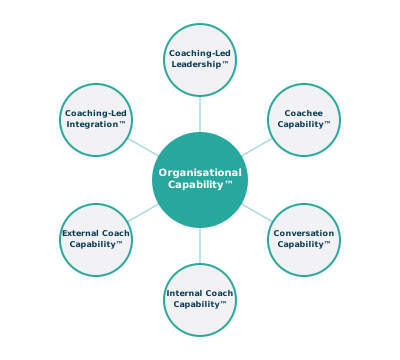
A Coaching-Led Organisation™ is an organisation that develops six interconnected capabilities to build organisational capability through coaching as a continuous, integrated practice. Unlike traditional approaches that treat coaching as an isolated programme, the framework embeds coaching capability across leadership, individual development, conversations, internal and external coaching expertise, and organisational systems.
Organisations invest billions in coaching each year. Yet most treat it as a series of disconnected interventions: executive coaching for senior leaders, a manager training programme here, a coaching culture initiative there. The result is fragmented capability. Coaching happens, but it does not build the organisational capability to develop people continuously.
The conversation about whether coaching culture is dying has been growing for some time. What is needed is not a better programme but a different model entirely: one that treats coaching not as an event but as an organisational capability.
The Coaching-Led Organisation™ framework addresses this by defining six interconnected organisational capabilities. Each capability strengthens a different aspect of performance and development. Together, they create an integrated system that enables organisations to improve performance today while continually building the capability required for tomorrow.
This matters now more than ever. The World Economic Forum estimates that 39% of workers' core skills will become obsolete by 2030. Gallup research shows that managers account for 70% of the variance in team engagement. The organisations that thrive will be those that build the capability to develop people continuously, not through occasional programmes but through an integrated coaching-led approach.
What Are the Six Capabilities of a Coaching-Led Organisation™?
The Six Capabilities™ framework defines six interconnected organisational capabilities that together create the organisational capability required to become a Coaching-Led Organisation™.
Each capability has a distinct purpose, addressing a specific dimension of how organisations lead, develop and perform. While each capability delivers value independently, the greatest organisational impact is achieved when they are developed together. A leader who coaches but works within systems that do not reinforce coaching behaviour will see that behaviour fade. An internal coach team that builds capability but operates outside the leadership agenda will remain marginal. The framework's power lies in the connections between its components.
What Is Coaching-Led Leadership™?
Coaching-Led Leadership™ is the capability of leaders to build the capability of the people they lead while delivering performance, through coaching behaviours embedded in everyday management practice.
Gallup's research consistently shows that managers account for 70% of the variance in team engagement. DDI's Global Leadership Forecast 2025 found that only 40% of leaders rate their organisation's leadership quality as high, while 83% of HR leaders report a growing demand for new leadership skills. The gap between what leaders are asked to do and what they are equipped to do has never been wider.
Coaching-Led Leadership™ addresses this gap by redefining leadership development. It moves coaching skills from an optional add-on to a core leadership expectation. Leaders are developed not only to deliver performance but to build the leader as a coach capability of their people simultaneously. This is not about turning every manager into a professional coach. It is about ensuring every leader can hold a developmental conversation that builds capability rather than simply allocating work.
The shift from boss to coach is not a personality change. It is a capability change. It requires leaders to develop the habits of inquiry, listening and developmental challenge that make coaching-led leadership a daily practice rather than a quarterly initiative.
The outcome is leaders who understand that their job is not only to produce results but to produce people who can produce results. In a Coaching-Led Organisation™, this is not a supplementary responsibility. It is the leadership job.
What Is Coachee Capability™?
Coachee Capability™ is the capability of individuals to take ownership of their own learning, development and performance, actively contributing to organisational capability rather than passively receiving coaching.
The World Economic Forum's Future of Jobs Report 2025 estimates that 39% of workers' core skills will change by 2030, and 59% of workers will require significant reskilling. In this environment, the idea that development is something done to people by organisations is no longer viable. Individuals must be active participants in their own development.
Coachee Capability™ recognises that coaching is most effective when the coachee is equipped to make the most of it. This means individuals who can reflect on their own performance, identify their own development needs, and take ownership of their learning. It means addressing coachee readiness as a precondition for effective coaching, not an afterthought.
It also means addressing the barriers that prevent people from engaging fully. A lack of confidence in a coachee is one of the most common obstacles to effective coaching, and building Coachee Capability™ requires explicit attention to the confidence and self-awareness that enable people to engage in their own development.
The outcome is people who actively contribute to organisational capability, not because they are told to but because they are equipped to.
What Is Conversation Capability™?
Conversation Capability™ is the capability of an organisation to conduct purposeful conversations that strengthen thinking, collaboration, learning and decision-making at every level.
The Center for Creative Leadership argues that conversations are the most basic building block of organisational culture. McKinsey's research on courageous conversations found that organisations that embed honest, growth-focused dialogue into their culture are more likely to build trust and sustain performance. The quality of an organisation's conversations determines the quality of its thinking, and the quality of its thinking determines the quality of its decisions.
Conversation Capability™ goes beyond individual coaching skills. It addresses the conversational patterns that shape how teams work together, how decisions are made, and how learning happens. This includes the everyday conversation habits that build trust and engagement over time, and the structured coaching models that give conversations purpose and direction.
It also encompasses the harder conversations: the ones where teams must work through disagreement, navigate conflict, and hold each other accountable. In a Coaching-Led Organisation™, the ability to engage in difficult, honest dialogue is not a specialist skill reserved for trained coaches. It is a shared conversational capability that every leader and team member is expected to develop.
The outcome is conversations that continually strengthen organisational capability, rather than conversations that merely exchange information.
What Is Internal Coach Capability™?
Internal Coach Capability™ is the capability of an organisation to develop and sustain professional internal coaches who strengthen leadership, talent and organisational capability.
The 2016 meta-analysis by Jones, Woods and Guillaume, published in the Journal of Occupational and Organisational Psychology, found that workplace coaching delivered by internal coaches was more effective than coaching delivered by external professionals. This finding challenges the assumption that external coaching is inherently superior. When organisations build internal coaching capability, they invest in a sustainable resource that compounds over time.
Internal Coach Capability™ is not about asking managers to coach. It is about developing a professional internal coaching function: individuals who are trained, supervised, and deployed to build capability across the organisation. This requires attention to the professional infrastructure that makes internal coaching effective, including clear contracting practices that establish clear agreements, and the four stages of a coaching assignment that give internal coaching programmes structure and rigour.
The outcome is a sustainable internal coaching capability that does not depend on external providers or annual budget cycles.
What Is External Coach Capability™?
External Coach Capability™ is the capability of an organisation to access and integrate trusted external coaching expertise that complements internal capability and supports organisational priorities.
External coaching remains valuable. Specialist expertise, objective perspective, and experience across multiple sectors are assets that internal coaches cannot always provide. The question is not whether to use external coaches but how to integrate them strategically.
In a Coaching-Led Organisation™, external coaching is not a substitute for internal capability. It is a complement. External coaches are deployed where specialist expertise is needed: executive transitions, complex team dynamics, sector-specific challenges. The organisation maintains clear ownership of its coaching agenda, ensuring that external expertise builds rather than replaces internal capability.
This requires a deliberate approach to managing external coaching relationships, including clear briefs, alignment with internal development priorities, and knowledge transfer that ensures the organisation benefits from the engagement long after it concludes.
The outcome is specialist coaching expertise aligned to organisational priorities, deployed where it adds the most value.
What Is Coaching-Led Integration™?
Coaching-Led Integration™ is the capability of an organisation to align leadership, learning, talent and organisational systems so that coaching-led capability becomes part of everyday organisational practice rather than a separate initiative.
This is the capability that binds the others together. Without it, organisations develop coaching skills but do not change the systems that shape how leaders lead, how people are developed, and how performance is managed. Coaching capability becomes a layer on top of existing practice rather than woven through it.
Deloitte's High-Impact Learning Culture research found that organisations with strong learning cultures significantly outperform those without, not because they run more programmes but because learning is embedded in how work happens. The same principle applies to coaching-led capability. When leadership expectations, talent processes, performance management, and learning systems are all aligned around coaching-led principles, the capability compounds. When they are not, it erodes.
Coaching-Led Integration™ means that building workplace coaching capacity is not a separate workstream. It is part of how the organisation hires, develops, promotes, and measures its people. Coaching-led principles appear in leadership competency frameworks, in performance conversations, in team rituals, and in the way the organisation talks about success.
The outcome is integrated organisational systems that sustain coaching-led capability over time.
Why Must the Six Capabilities Be Developed Together?
The six capabilities are designed to be developed as an integrated system because the connections between them are where the greatest organisational value is created.
Coaching-Led Leadership™ without Coachee Capability™ produces leaders who ask good questions of people who are not equipped to answer them. Coachee Capability™ without Conversation Capability™ produces motivated individuals who lack the conversational environment to develop. Internal Coach Capability™ without Coaching-Led Integration™ produces professional coaches who sit outside the organisational system, their expertise untapped.
The framework's design principle is that organisational capability is emergent. It is not the sum of individual capabilities but the product of their interaction. An organisation that develops all six capabilities creates a system in which coaching-led behaviour is reinforced at every level: by leaders who expect it, by individuals who are equipped for it, by conversations that enable it, by coaches who strengthen it, and by systems that sustain it.
This is what distinguishes a Coaching-Led Organisation™ from an organisation that does coaching. The latter has programmes. The former has capability.
The Six Capabilities™ framework does not describe a destination. It describes an organisational capability system: one that builds performance today while continually strengthening the capability required for tomorrow.
The question for organisational leaders is not whether to invest in coaching. The evidence on that is settled. The question is whether to continue investing in coaching as a series of disconnected interventions, or to build something more integrated, more sustainable, and more capable of producing the leaders, conversations, and culture that organisational performance requires.
The Coaching-Led Organisation™ is the answer to that question. Not a programme. Not an initiative. A capability system.
Frequently Asked Questions
What is a coaching-led organisation and how is it different from a coaching culture?
A coaching culture is an environment where coaching behaviours are encouraged and practised. A Coaching-Led Organisation™ goes further: it treats coaching as an integrated organisational capability system with six interconnected components, not as a cultural initiative or programme. The difference is structural. A coaching culture can fade when the initiative ends. A Coaching-Led Organisation™ builds coaching capability into its leadership expectations, talent systems, and organisational processes so it is sustained regardless of who is in charge.
How do the six capabilities of a coaching-led organisation work together?
Each capability addresses a different dimension of organisational performance. Coaching-Led Leadership™ equips leaders to build capability. Coachee Capability™ equips individuals to take ownership of development. Conversation Capability™ shapes the quality of dialogue. Internal and External Coach Capability™ provide professional coaching expertise. Coaching-Led Integration™ aligns organisational systems to sustain it all. Together, they create a reinforcing system where each capability strengthens the others.
Can small organisations adopt the coaching-led organisation framework?
Yes. The framework is scalable. A small organisation may not need a dedicated internal coaching function, but it still benefits from developing coaching-led leadership, coachee capability, conversation capability, and systems integration. The principles apply regardless of size. What changes is the depth and formality of implementation.
What is the first capability an organisation should develop?
Most organisations begin with Coaching-Led Leadership™ because it creates the foundation for everything else. When leaders model coaching behaviours, they create the conditions for Coachee Capability™ and Conversation Capability™ to develop. However, the framework is designed to be developed holistically. Starting with one capability while planning for the others prevents the fragmentation the framework was designed to address.
How long does it take to build the six capabilities?
Building all six capabilities is a multi-year journey, not a quarterly initiative. Individual capabilities can show results within months. Coaching-Led Leadership™ habits can shift with targeted development. Internal Coach Capability™ can be established with a training programme. But the integration of all six into a self-sustaining system typically takes three to five years, depending on organisational size and starting point.
Do all six capabilities need to be developed simultaneously?
No, but they need to be developed with awareness of each other. The most common failure mode is developing one capability in isolation, which produces fragmentary results. A phased approach that starts with one or two capabilities while maintaining a roadmap for the others is more effective than attempting everything at once. The key is that each capability development plan should account for how it will connect with the others.
Key Takeaways
1. Gallup research shows that managers account for 70% of the variance in team engagement, making Coaching-Led Leadership™ the foundational capability for organisational performance.
2. The World Economic Forum estimates that 39% of workers' core skills will become obsolete by 2030, requiring Coachee Capability™ to enable continuous learning and reskilling.
3. DDI's Global Leadership Forecast 2025 found that only 40% of leaders rate their organisation's leadership quality as high, while 83% of HR leaders report a growing demand for new leadership skills.
4. Jones, Woods and Guillaume's 2016 meta-analysis found that internal coaches produced stronger outcomes than external coaches, making Internal Coach Capability™ a strategic investment.
5. The Center for Creative Leadership identifies conversations as the most basic building block of organisational culture, making Conversation Capability™ essential for sustained performance.
6. Deloitte's High-Impact Learning Culture research shows that organisations with embedded learning cultures significantly outperform those without, demonstrating the value of Coaching-Led Integration™.
7. The six capabilities are interconnected: each strengthens the others, and the greatest organisational impact is achieved when they are developed together as an integrated system rather than in isolation.

Trayton Vance
Trayton Vance is the Founder and Managing Director of Coaching Focus Group, one of the UK’s leading leadership coaching consultancies working with clients such as McDonalds, Beats by Dre, Paramount and many more.
Coaching Focus Group
Specialists in leadership coaching, workplace coaching programmes, and building coaching cultures that stick.


You might be interested in...


Employee Engagement Series