Burnout. What It Is and How to Recover


Burnout isn’t laziness.
It isn’t weakness.
And it sure as hell isn’t a motivation problem.
Burnout is what happens when human energy systems are treated like they’re infinite—and then blamed when they fail.
What Is Burnout Really?
Burnout is a state of chronic physical, emotional, and cognitive depletion caused by prolonged stress without adequate recovery. It’s not just feeling tired; it’s loss of capacity.
According to research and practical experience, burnout shows up when three things collide:
- Sustained stress
- Lack of recovery
- Perceived lack of control or meaning
A helpful framework popularised in Burnout: The Secret to Unlocking the Stress Cycle explains this well: stress isn’t the enemy - unfinished stress is. When stress signals stay active in the body without resolution, burnout becomes inevitable.
Burnout is not an event.
It’s a process.
How Is Burnout Actually Created?
Burnout doesn’t come from one bad week. It’s built through patterns that look normal, responsible, and even admirable - until they aren’t.
1. Chronic Overload
Too much work, too many priorities, constant urgency. Not occasional sprints - permanent sprints.
When everything is important, the nervous system never stands down.
2. High Effort + Low Recovery
You can handle intense work if recovery is real. Most people replace recovery with:
- Scrolling
- Doom-checking email
- “Resting” while still mentally on call
That’s not recovery. That’s delayed stress.
3. Identity Tied to Performance
When worth = output, rest feels unsafe.
People keep going not because they want to - but because stopping feels like failure.
This is common in high performers, leaders, caregivers, and anyone rewarded for being “reliable.”
4. Loss of Autonomy
Burnout accelerates when people feel trapped:
- No say in priorities
- No control over pace
- No ability to say no
Even meaningful work becomes draining when agency disappears.
5. Values Mismatch
Doing work that conflicts with personal values or doing good work in a broken system creates moral fatigue, which burns deeper than physical exhaustion.
What Are the Real Symptoms of Burnout Beyond Feeling Tired?
Burnout is sneaky because many people stay productive while burning out. That’s why it’s often missed.
Physical Symptoms
- Constant fatigue that sleep doesn’t fix
- Frequent illness
- Headaches, muscle pain, gut issues
- Hormonal disruption
- Insomnia or non-restorative sleep
Emotional Symptoms
- Irritability or numbness
- Loss of enthusiasm
- Cynicism
- Anxiety or low-grade dread
- Emotional flatness (“I don’t care anymore”)
Cognitive Symptoms
- Brain fog
- Poor concentration
- Forgetfulness
- Decision fatigue
- Reduced creativity
Behavioural Symptoms
- Working longer with less output
- Avoidance or procrastination
- Withdrawal from people
- Short temper
- Using caffeine, sugar, or alcohol to cope
The most telling sign?
You’re still functioning, but it costs you everything.
Does Pushing Through Burnout Make It Worse?
Yes. Burnout isn’t solved by grit. In fact, grit often causes it.
When someone is burned out:
- Motivation drops because the nervous system is protecting itself
- Focus declines because stress narrows cognition
- Energy collapses because the body is conserving resources
Trying to “power through” signals danger to the system. The result?
More shutdown. More exhaustion. More mistakes.
Burnout is the body saying:
This pace is not survivable.
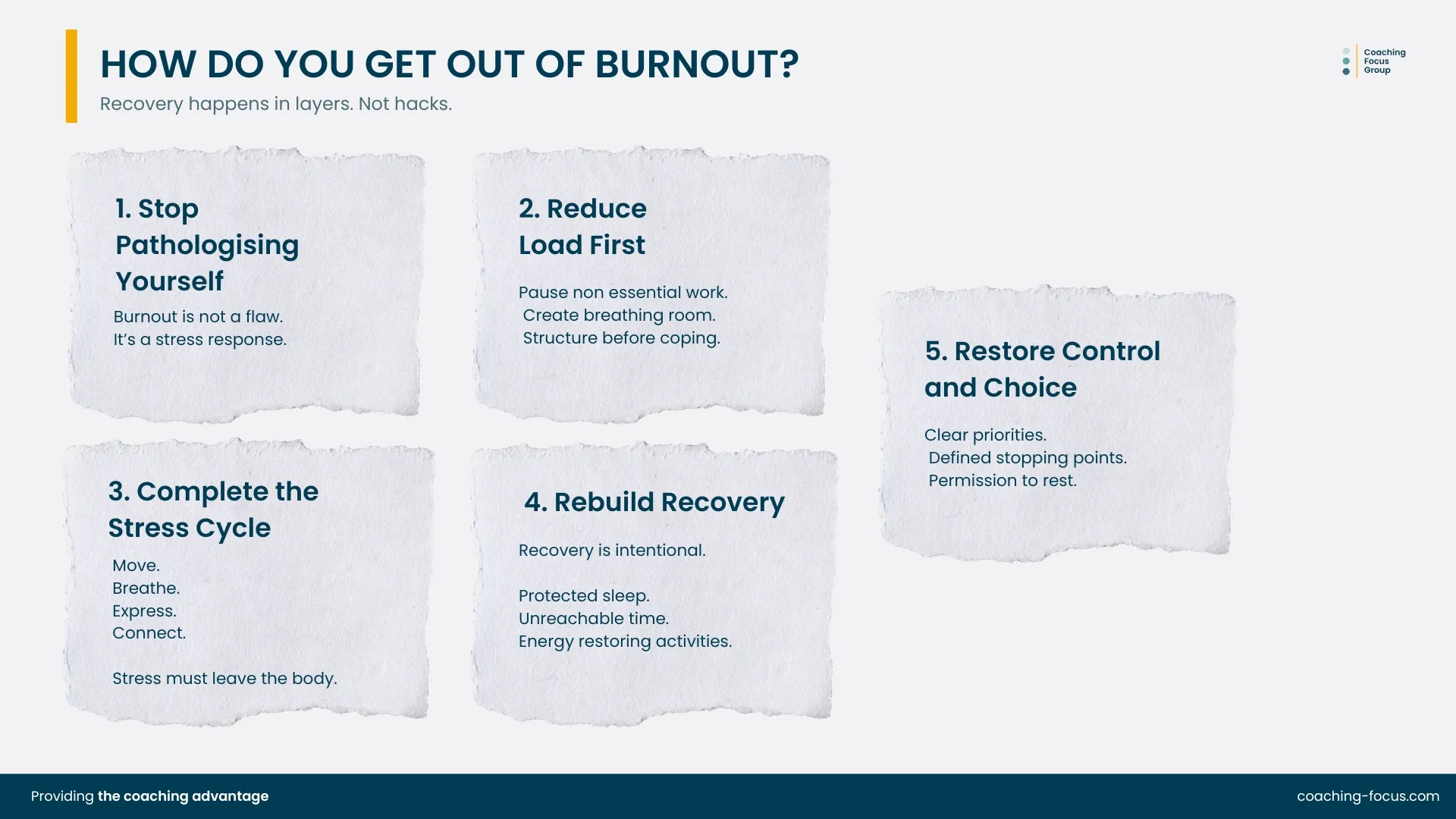
How Do You Get Out of Burnout?
There is no single fix. Recovery happens in layers, not hacks.
Step 1: Stop Pathologising Yourself
Burnout is not a character flaw.
It’s a predictable response to chronic stress.
This mental shift matters because shame keeps people stuck in overdrive.
Step 2: Reduce Load Before You Add Coping
You cannot meditate your way out of an impossible workload.
Recovery starts by:
- Removing or pausing non-essential work
- Renegotiating deadlines
- Saying no to “nice-to-haves”
- Creating breathing room
If nothing changes structurally, burnout returns.
Step 3: Complete the Stress Cycle
Stress must be discharged physically. That means:
- Movement (walking, strength, shaking it out)
- Breathing that downshifts the nervous system
- Emotional expression (talking, crying, laughing)
- Safe connection with others
Thinking your way out doesn’t work. The body must be involved.
Step 4: Rebuild Recovery as a Skill
Recovery isn’t passive. It’s intentional.
Real recovery includes:
- Time where you’re not reachable
- Activities that restore energy, not just distract
- Sleep that’s protected, not negotiated
- Mental off-ramps from constant vigilance
If recovery feels uncomfortable at first, that’s normal. Burnout conditions people to stay “on.”
Step 5: Reestablish Control and Choice
Sustainable performance requires agency:
- Clear priorities
- Defined stopping points
- Autonomy over how work is done
- Permission to rest without justification
Even small choices rebuild capacity.
What Does Sustainable, Healthy Performance Look Like?
The goal isn’t to do less forever.
It’s to work in a way your system can sustain.
Sustainable performance looks like:
- Cycles of effort and recovery
- Fewer priorities, better execution
- Clear boundaries
- Energy management over time management
- Output that doesn’t cost your health
High performance doesn’t disappear when burnout is addressed it improves. Focus sharpens. Creativity returns. Decision-making stabilizes.
The difference?
You’re no longer running on fumes.
What’s the Hard Truth About Burnout?
Burnout doesn’t mean you’re broken. It means something about how you’re working or living needs to change.
Ignoring burnout is expensive.
Addressing it is uncomfortable.
Recovering from it is possible.
And sustainable performance isn’t about doing more. It’s about building a system where humans can last.
FAQs About Burnout
1. What is burnout really?
Burnout is chronic physical, emotional, and cognitive depletion caused by prolonged stress without adequate recovery. It’s not just tiredness. It’s a loss of capacity across your body and mind.
2. How does burnout develop over time?
Burnout builds through patterns that often look normal or even responsible. Chronic overload, high effort with low recovery, loss of autonomy, and tying identity to performance slowly drain the system until it can no longer keep up.
3. Why doesn’t pushing through burnout work?
When you push through burnout, the nervous system interprets that as danger. Energy drops, focus narrows, and mistakes increase. What feels like a motivation problem is actually a protection response.
4. What actually helps burnout recovery?
Real recovery starts by reducing load before adding coping strategies. Stress needs to be discharged physically, not just managed mentally. Rebuilding recovery, restoring choice, and creating sustainable rhythms of effort and rest are what allow capacity to return.
Summary: Burnout. What It Is and How to Recover
Burnout isn’t about motivation or resilience. It’s what happens when sustained stress meets insufficient recovery and loss of control. Recovery doesn’t come from pushing harder. It comes from reducing load, completing stress in the body, and rebuilding recovery as a skill. Sustainable performance is possible, but only when the system supporting the human actually works.

Trayton Vance
Trayton Vance is the Founder and Managing Director of Coaching Focus Group, one of the UK’s leading leadership coaching consultancies working with clients such as McDonalds, Beats by Dre, Paramount and many more.
Coaching Focus Group
Specialists in leadership coaching, workplace coaching programmes, and building coaching cultures that stick.


You might be interested in...

Employee Engagement Series