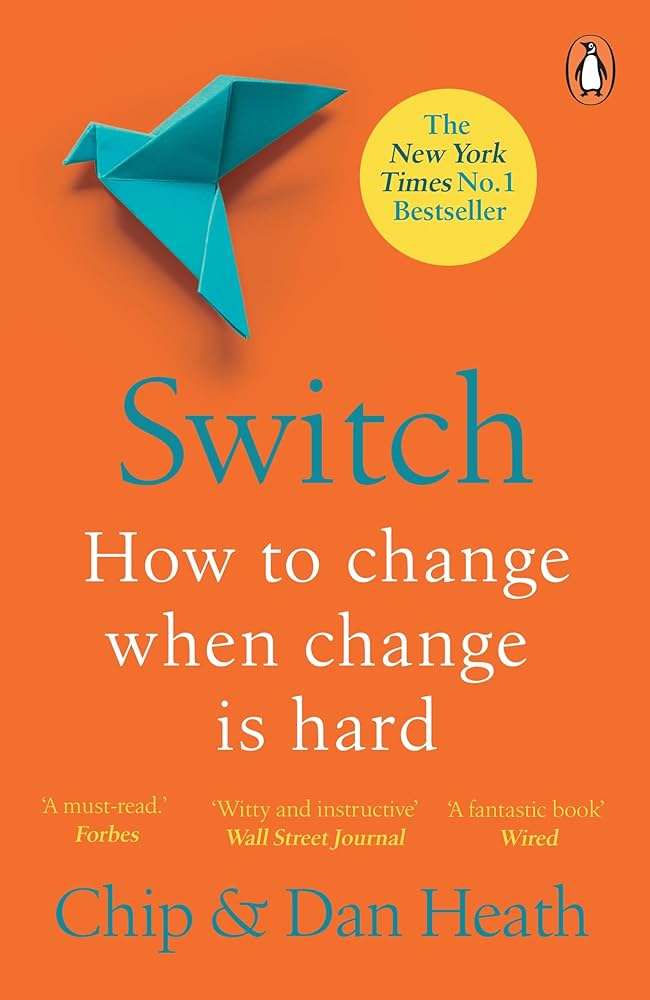
Switch: How to Change Things When Change Is Hard by brothers Chip and Dan Heath

Ever tried to get someone to adopt a new habit... and failed? Maybe you've introduced a new system at work, only to be met with sighs, side-eyes, and silent resistance. Sound familiar?
You're not alone. Change—whether personal or professional—can feel like dragging a boulder uphill in flip-flops.
That's where Switch: How to Change Things When Change Is Hard by brothers Chip and Dan Heath swoops in like a breath of fresh, practical air.
This isn’t your average change management manual. It’s a story-rich, mind-shifting guide that makes the science of change feel surprisingly human and doable.
So what’s the big idea?
The Heaths say every change effort must appeal to both head and heart. They introduce a brilliantly simple metaphor: the Rider, the Elephant, and the Path.
- The Rider is your rational side. Loves logic. Obsesses over spreadsheets.
- The Elephant is your emotional side. Craves comfort. Resists disruption.
- The Path is your environment. The road you're travelling.
If you want real, lasting change? You need to direct the Rider, motivate the Elephant, and shape the Path. All three. Not just one.
Let’s break it down.
1. Direct the Rider
The Rider needs clarity. If the goal is vague—“be more efficient”—they’ll spin in circles. But if it’s crystal-clear—“send all Monday emails before 10am”—they move.
Clarity isn’t just kind. It’s catalytic.
2. Motivate the Elephant
Change is emotional. No amount of logic alone will move hearts. You’ve got to tap into feelings. Share stories. Celebrate early wins. Build momentum that feeds the soul, not just the KPI dashboard.
3. Shape the Path
Sometimes it’s not the person—it’s the situation. The Heaths show how small tweaks to environment or defaults can spark big behavioural shifts. Think fewer steps. Fewer decisions. More ease.
One standout lesson? What looks like resistance is often a lack of clarity. What looks like laziness is often exhaustion. What looks like a people problem is often a situation problem.
Powerful, right?
Switch is packed with punchy examples—from turning around a hospital’s hygiene crisis to helping kids eat healthier school lunches. It proves that big change is possible—even joyful—when you understand the levers that move people.
So if you’re leading a team, coaching clients, or just trying to finally make that new habit stick?
This book’s your playbook.
Because change doesn’t have to be hard.
It just needs the right kind of push.
What is the central metaphor in Switch?
The Rider (rational mind), the Elephant (emotional mind), and the Path (environment). Lasting change requires addressing all three simultaneously.
Why do change efforts often fail?
Most efforts focus only on the rational mind and ignore emotion and environment — without all three, even well-intentioned change stalls.
Is Switch applicable to workplace change?
Very much so. Its frameworks are widely used in leadership, organisational change, and coaching to design change that actually sticks.
What does 'Shape the Path' mean?
Adjusting the environment to make the desired behaviour easier — removing obstacles and building conditions for change rather than relying on willpower alone.