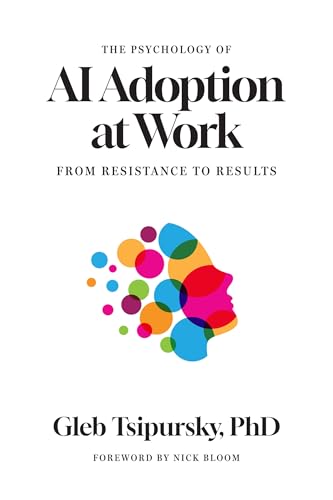
The Psychology of AI Adoption at Work: From Resistance to Results - Gleb Tsipursky
Most AI programmes do not fail because the model is not good enough.
They fail because the people expected to use it quietly decide not to.
That is the premise of The Psychology of AI Adoption at Work: From Resistance to Results, Gleb Tsipursky's eighth book, published by Georgetown University Press on 1 September 2026 after peer review.
Tsipursky is a behavioural scientist and chief executive of Disaster Avoidance Experts, and the New York Times gave him a memorable shorthand in 2023: the Office Whisperer. His argument here is that organisations treat AI as a software rollout when it is a change in what people do all day, and that the resistance this produces is information rather than disobedience.
The evidence base is his own practice, and he is explicit about it: frameworks, conversation scripts and metrics drawn from more than 100 consulting projects, alongside over 50 interviews with leaders at Microsoft, Uber, Experian and other firms. The foreword is by Nick Bloom, the Stanford economist.
The backdrop explains the urgency. Research from MIT's NANDA initiative, reported by Fortune, found that 95% of enterprise generative AI pilots were delivering no measurable impact on profit and loss (Fortune, 2025). The same analysis found that buying from specialist vendors succeeded around two thirds of the time, while internal builds worked roughly one third as often. Pew Research Center surveys consistently find around half of adults more concerned than excited about AI, against roughly one in ten the other way round (Pew Research Center).
So the technology arrives into a workforce that is anxious, a middle layer that is exposed, and an evidence base that says most pilots stall. Tsipursky's answer is psychological, and it is more specific than the usual call for a positive culture.
What Are the Book's Core Ideas?
The book runs to fifteen chapters, moving from psychology through structure, risk, engagement and governance to measurement and leadership. Four ideas do most of the work.
Resistance is a set of specific threats, not a personality trait
Chapter two sets out the central claim. In his own summary of the research, Tsipursky says resistance to AI often comes from “perceived threats to competence, autonomy, status, fairness, and job security”, compounded by uncertainty about how decisions will be made.
That list is useful because it is diagnosable. A tool that might reveal you are slower than a colleague threatens competence. A tool that removes discretion over how you work threatens autonomy. A tool that devalues a skill you spent a decade building threatens status. None of those reactions is irrational, and none is fixed by a training session.
Technical and structural roadblocks are treated as real
Chapter three addresses the technical and structural obstacles to adoption, and chapter four works through the risks. This matters for the book's credibility. A weaker version would have insisted that everything is mindset. Tsipursky does not: poor data, clumsy integration and badly procured tools generate resistance that is entirely rational, and they sit alongside the psychological pressures rather than beneath them.
Resistance has different profiles at different levels
Two separate chapters map psychographic profiles, one for middle managers and one for employees. The structural choice is deliberate. A middle manager facing AI carries a different set of exposures from a frontline employee: accountability for a team's output, exposure to headcount questions, and often the job of explaining a decision they did not make. A single engagement campaign addressed to “the workforce” will miss both groups.
Safety, champions, learning and guardrails are the delivery mechanism
The second half is practical. Chapter seven lays the foundation for employee engagement, which the publisher describes as building the psychological sense of safety required for AI-powered innovation. Chapters eight and nine turn early adopters into champions and scale engagement through communication and collaboration. Chapter ten makes continuous learning the cornerstone of adoption. Chapter twelve covers ethical stewardship, governance and risk management. Chapter thirteen addresses measuring and optimising adoption.
The recurring formula across those chapters is the one Tsipursky gives in interviews: adoption improves when leaders supply “clear guardrails, agency, psychological safety to experiment, practical coaching, and visible examples of how AI helps with real work”.
Why Does This Matter for a Coaching Led Organisation?
Because every mechanism in the book is a conversation.
A Coaching Culture encourages coaching. A Coaching Led Organisation uses coaching conversations to shape how work actually gets done. AI adoption is an unusually clean test of which one you have, because the behaviour required is specific, visible and happening now, and because the people who must change are the same people managers are already meeting every week. We have written elsewhere about what a coaching culture is and why the distinction matters. Tsipursky's argument lands squarely on that ground: the obstacle is not the technology but the conversations that never happen about it.
He makes a related point in a Harvard Business Review article published in the same week as the book, titled “Middle Managers Will Make or Break AI Adoption”. That is a structural insight coaching has been slow to act on. The middle layer decides whether a strategy ever reaches the work.
Worth being clear about the boundary, though. This is a leadership book, not a coaching book. It supplies the material, the language and the scripts; it does not supply the coaching method. That translation is the reader's work, and for leadership coaches it is the most valuable part.
How Can Leaders Apply the Ideas?
The book is written to be used rather than admired, and five moves carry most of the practical weight.
Name the threat before the tool
Open with the question people are actually asking, which is what this means for my role, my standing and my team. A launch that begins with features and ends with reassurance has the order wrong. Coaching language helps here: ask what they are worried about losing, and do not argue with the answer.
Offer one low-risk experiment
Agency is the antidote to a competence threat. Give people a task they already do well and let them test the tool against their own standard, with permission to conclude it is not helping. A failed experiment that was genuinely optional costs far less than a mandated rollout that quietly gets ignored.
Protect the people who admit they are struggling
Psychological safety is not a survey score; it is what happens to the first person who says the output was wrong or the tool was confusing. If that admission is met with a judgement about their capability, the rest of the team learns to stay quiet, which is why building trust within the workplace has to come before the rollout.
Recruit champions rather than mandate compliance
Chapters eight and nine make the case for building from early adopters outward. Mandates produce use; champions produce adoption. The difference is visible in whether people use the tool when nobody is checking.
Measure a workflow, not a mood
Chapter thirteen is the one leaders skip and should not. Enthusiasm in a pulse survey is not evidence. Pick one workflow, describe how long it takes now, and check again in a month.
How Can Leadership Coaches Apply the Book?
1. Put AI resistance on the coaching agenda
Most coaching contracts never mention AI, which is strange given how much of the anxiety in the room is now connected to it. One question opens the topic without forcing it: what has changed about your work that we have not talked about yet?
2. Coach the middle manager first
If the middle layer makes or breaks adoption, that is where coaching hours should go. These are the people caught between an executive mandate and a sceptical team, and they are frequently the least supported group in the organisation.
3. Use the five threats as a diagnostic
Competence, autonomy, status, fairness and job security give a coach a precise vocabulary. When someone says they are “not convinced by AI”, the useful next question is which of the five is actually at stake. Answering that requires the kind of attention we describe in the art of listening in coaching. The answer changes the intervention entirely.
4. Rehearse the conversation, not the policy
The book includes conversation scripts, which is unusual and welcome. Coaches can use them as rehearsal material, letting a manager practise the announcement, the pushback and the awkward follow-up question where the stakes are low.
5. Keep the ethical questions in the room
Chapter twelve treats governance as part of adoption rather than an obstacle to it. Coaches are well placed to hold that line when a client wants to move fast, because the questions about bias, oversight and accountability are coaching questions as much as compliance ones.
What Are the Book's Strengths?
The evidence base is real
More than 100 consulting projects and over 50 leader interviews, including at Microsoft, Uber and Experian, give the book a grounding that most AI books lack. Tsipursky is a behavioural scientist writing about behaviour he has watched at close range.
Resistance is treated with respect
The book's refusal to caricature sceptics is its best quality. Resistance is presented as information about what people stand to lose, which changes how a leader is invited to respond.
Breadth with practical materials
Frameworks, conversation scripts and metrics are promised, and the chapter structure supports the promise. It is a working manual as much as an argument.
Institutional backing
Georgetown University Press published it after peer review, Nick Bloom wrote the foreword, and the endorsements include Amy Edmondson, Thomas Davenport and Jonah Berger. Edmondson's line is the one to remember: the book helps leaders build “the trust and psychological safety people need to embrace AI as a partner in their work rather than reject it as a threat”.
What Are Its Limitations?
The surface will date, and the author says so
Asked directly about this, Tsipursky acknowledges that “those surface details will age. The psychological mechanisms move much more slowly”. He is right on both counts, and readers should expect model names and tool examples to feel dated sooner than the argument does.
The evidence is consulting practice, not independent field trials
This is the strongest caveat. Client projects and leader interviews produce insight and credibility, but they are not controlled studies, and the author is reporting his own work. The claims are plausible and well argued, but they are not independent verification.
Fifteen chapters in 280 pages favours breadth
The range is impressive: psychology, structure, risk, engagement, learning, governance, innovation, measurement and leadership. The cost is depth. Chapters such as the one on measurement will start conversations rather than settle them, and teams with a mature analytics function may want more.
It is not a coaching manual
The scripts are conversation prompts, not coaching technique. Coaches looking for a method should bring their own, and use this book for context and language, in the same way we suggest in harnessing AI to elevate your coaching practice.
Key Takeaways for Leadership Coaches
1. MIT's NANDA research, reported by Fortune, found 95% of enterprise generative AI pilots delivering no measurable impact on profit and loss.
2. The same analysis found specialist vendor purchases succeeding around two thirds of the time, while internal builds worked roughly one third as often.
3. Pew Research Center surveys consistently put around half of adults more concerned than excited about AI, against roughly one in ten the reverse.
4. Tsipursky's evidence base is more than 100 consulting projects and over 50 interviews with leaders at Microsoft, Uber, Experian and other firms.
5. He traces resistance to five perceived threats: competence, autonomy, status, fairness and job security.
6. The book spans fifteen chapters and 280 pages across psychology, structure, risk, engagement, learning, governance and measurement.
7. Adoption improves when leaders provide clear guardrails, agency, psychological safety to experiment, practical coaching and visible examples of AI helping with real work.
What Is the Final Verdict?
The Psychology of AI Adoption at Work is the most useful book on AI adoption published this year for people whose job is to make it happen, and it earns that description by taking resistance seriously rather than treating it as an attitude problem.
Its strengths are specific: a credible evidence base, a chapter structure that respects the difference between middle managers and frontline employees, and a practical bias towards guardrails, champions, learning and measurement rather than slogans. Its limits are equally specific: the technology examples will date, the evidence comes from the author's own practice rather than independent trials, and breadth is bought at some cost in depth.
For leadership coaches, the value is indirect but real. This is not a coaching manual and does not pretend to be. What it offers is the context, the vocabulary and the scripts for a conversation that most organisations are currently avoiding, which is precisely the conversation coaching exists to host.
Recommended for leaders responsible for AI adoption, for HR and learning professionals designing upskilling, and for coaches supporting the managers in the middle.
1. What is The Psychology of AI Adoption at Work about?
It is a leadership guide to why generative AI initiatives stall despite good technology. Drawing on more than 100 consulting projects and over 50 interviews with leaders, it argues that resistance is psychological and often rational, and sets out frameworks, conversation scripts and metrics for moving from pilot to everyday use.
2. Who is Gleb Tsipursky?
A behavioural scientist and chief executive of Disaster Avoidance Experts, known for his work on decision-making and hybrid work. He has written eight books, including Never Go With Your Gut and The Blindspots Between Us, and the New York Times described him as the Office Whisperer in 2023.
3. What is the main argument of the book?
That AI adoption is a human behaviour and organisational change challenge rather than a software rollout. Resistance usually reflects perceived threats to competence, autonomy, status, fairness or job security, and leaders reduce it by supplying psychological safety, agency, clear guardrails, practical coaching and visible examples of the tool helping with real work.
4. Does the book cover ethics and governance?
Yes. Chapter twelve addresses ethical stewardship, governance and risk management, and an earlier chapter works through the risks of adoption. Governance is presented as something that makes adoption safer and faster rather than as an obstacle to it.
5. Is this a coaching book?
No. It is a leadership book about organisational change. Coaches will find it valuable for context, language and conversation scripts, but it does not teach coaching technique, and should be paired with coaching practice rather than used instead of it.
6. Will the book date quickly as AI tools change?
The author expects some of it to. Asked about this directly, Tsipursky said the tools, model names and specific examples will keep changing and those surface details will age, while the psychological mechanisms, such as loss aversion and status quo bias, move much more slowly. The argument is built to outlast the examples.